

Are Birman cats affectionate? Are they calm and sociable? Do Birman cats get on well with children and other pets? Do they need much grooming? Can Birmans be indoor cats? Find out more about these astonishingly beautiful and extremely loving lap cats.

Expert approved
Dr Suzanne Moyes MVB, MRCVS
29th May 2026
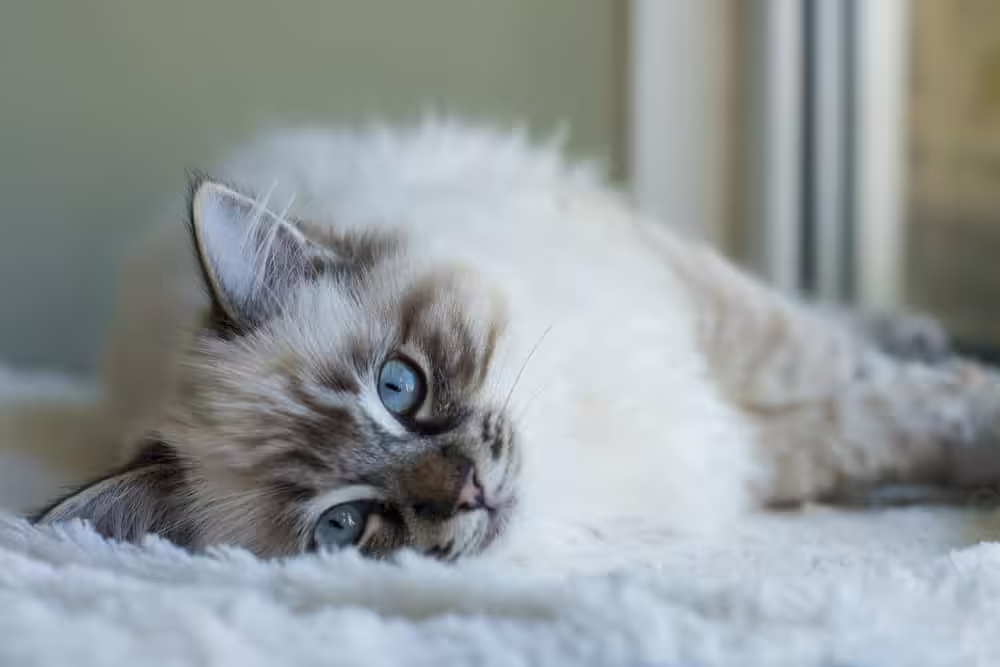
Imagine a cat with the fluffiest coat, bewitching blue eyes, and an affectionate nature, who loves to cuddle and be your devoted companion – and you have the beautiful Birman. It’s no surprise that this captivating feline has legions of admirers.
“The Birman is an incredibly gentle, loving cat,” enthuses the Governing Council of the Cat Fancy (GCCF). “With their striking good looks, ease of maintenance and friendly demeanour, no wonder the Birman is understandably a popular pet and figures in the Top 10 of breeds registered with GCCF.”
“Their loving and laid-back nature has captured the hearts of cat lovers around the world,” adds The International Cat Association (TICA).
“There’s an otherworldly cast to those enchanting blue eyes and a majestic air that accompanies these medium-to-large cats,” raves the Cat Fanciers’ Association (CFA). “With their fine, flowing coats subtly tinted with ‘golden mist’ and their long, yet stocky bodies accented with elegant, symmetrical markings, it’s easy to see why the Birman has made such a powerful impression on cat lovers worldwide.”
WHAT DO BIRMAN CATS LOOK LIKE?
A sizeable, solidly built cat, Birmans have a silky, soft, cream-coloured coat. Contrasting with their light coat are their darker ‘points’ – which come in seal, chocolate, lilac, red, tabbie and tortie – and feature on their face, ears, tail and legs. They also have four white ‘socks’.
“The defining features of the Birman are their wonderful blue eyes and four pure white feet,” states the GCCF. “The legendary Birman takes your breath away with its stunning pointed, semi-longhaired coat and bewitching deep sapphire blue eyes,” adds TICA.
WHERE DO BIRMAN CATS COME FROM?
These stunning felines, said to be descendants of temple cats from ancient Burma (now Myanmar), have an intriguing back story. Legend has it that marauders raided the Temple of Lao-Tsun during a stormy night, killing the elderly head priest, Mun-Ha. His devoted white cat, Sinh, placed his paws on the priest's body. The priest's soul entered the cat, turning its white coat golden, its eyes to sapphire blue, leaving its paws snowy white to denote purity.
“Numerous folk tales describe how the Birman obtained its unique markings, while the real Birman history keeps everyone guessing,” notes the CFA.
According to the GCCF, two westerners, Auguste Pavie and Major Gordon Russell, came to the aid of the priests when their temple was again raided at the beginning of the 19th century. Following their return to France, the priests sent them a pair of Burmese cats as a thank-you. “The Birman was first recognised and shown in France in the 1920s. England then recognised the breed in 1966,” says TICA. “The word Birman is derived from the French ‘Birmanie’ for Burma,” adds the GCCF.
Read on to find out more about Birman cats. Are they good with children and other pets? Are they playful and affectionate? What do Birmans like to do? From grooming and playtime to feeding, find out how to provide Birman cats with everything they need to live a fulfilling and happy life.
But first, check out these Birman cat facts!
7 BRILLIANT BIRMAN CAT FACTS
- Birman cats are medium to large in size. Adult females weigh between 6 to 10 pounds (2.7 to 4.5 kg), and adult males 10 to 15 pounds (4.5 to 6.8kg).
- Birman cats, like other colour-pointed felines, are born white, without their mask and points colour visible. While their colours begin to show at around 14 days old, they don’t fully develop until the cat reaches two years old.
- Birman cats all have blue eyes and four white paws. Their white front paws are called ‘gloves’, while the white markings which extend up the back of their hind legs are known as ‘laces’ or ‘socks’.
- Birman cats were almost extinct after WWII. Breeders crossed the surviving Birmans with Persians and Siamese cats to save the breed.
- Birman cats are generally a healthy breed and can live up to 15-plus years.
- Birman cats are also known as the Sacred Cat of Burma, due to their legendary history as temple cats.
- Birman cats are affectionately referred to as a ‘Velcro’ cat, due to their tendency to follow their human around throughout the day.
BIRMAN CAT PERSONALITY PROFILE
These endlessly curious, sociable cats just adore people and love being the centre of attention. They’ll also want to get involved with every activity!
“Birman cats love being introduced to new people and bask in attention and affection,” says TICA. “They are an extremely loving and loyal breed. More than anything, they love being held and relaxing in the arms of their caregiver.”
“They are wonderful companions with a lot of love to give,” notes the GCCF. “Birmans take an intelligent interest in everything their human families do – they will often follow you from room to room and want to be involved in what you are doing.”
And, with a little encouragement, Birmans can be quite chatty cats. “With a constant response from his owner when the cat meows, the Birman will become quite a talker (although nowhere near as vocal as its pointed cousin, the Siamese),” adds the GCCF.
“A Birman will let you know in an ever-so-gentle voice if they want or don’t want something, so make sure you’re listening carefully,” advises insurer Petplan.
Reported in Your Cat, Anne Madden, vice chairman of the Birman Cat Club, says: “The Birman cat makes an ideal pet. Not only are they very lovely to look at, but they are also affectionate and gentle. The only thing better than one Birman in the house is two, or even three. They were bred as companion cats – they love human company and are very curious, wanting to assist in all the household and garden chores.”
Understand your cat better with our cat communication guide >>
IS MY HOME SUITABLE FOR A BIRMAN CAT?
Birmans are home-loving cats who are happiest lounging around indoors, with occasional ventures outside.
“They are definitely indoor cats," says Amy Wilcox of the Northern Birman Cat Club, who has four of these fabulous felines. “Mine have the option of going outside under supervision if they want to, but one doesn't like going out, and the others can take it or leave it. I'd say Birmans would be happiest if they have access to an outside run so they can go out if they want to."
Your Cat recommends that if you live near a busy road or you don't have a garden, a Birman can enjoy life as an indoor cat as long as there are plenty of toys and activities to keep them occupied, adding: “If you decide to let them out, try to keep them in a safe, enclosed area so that they don’t roam too far.”
“Their friendly temperament and beautiful coat can make Birman cats a target for thieves,” warns Petplan. “Owners may wish to create secure outside areas, such as ‘catios’ with multi-level enrichment areas and safe cat-proof fencing.”
Adaptable Birmans suit all kinds of homes
Whatever your home set-up, Birmans will quickly settle in. “They are one of the easiest cats to handle and give the least cause for trouble. They love to be around people and can adapt to any type of home,” says TICA. “Their low-maintenance and desire for companionship also make them ideal for seniors. With lots of love, good food, fond grooming, and proper health care, the Birman makes the greatest buddy, friend, confidant, and all-around purrfect pet.”
“Birmans adore being around people and use a soft chirp-like mew to get attention. Eager to love and play but less inclined to hunt, Birmans make perfect family pets and are highly suitable for elderly people,” adds the GCCF.
Birman cats, other pets and children can get along well
Breed experts reveal that these mellow, mild-mannered felines will happily rub along with children and other pets.
“Their friendly, laidback personality is the perfect choice for families with children and cat-friendly dogs,” says TICA. “Because the Birman is patient, even-tempered, and tolerant, it makes an excellent choice for families with children and other pets,” adds the CFA.
“Birmans make great family cats due to their affectionate temperament and love to be handled and cuddled,” adds Petplan. “They are great companions and make a lovely first-time cat. As with any cat, though, make sure you give your Birman plenty of space and learn to recognise when they need some alone time. Like all cats, the Birman needs somewhere they can feel safe and secure, so make sure they have a dedicated area that they can go to when they’re feeling overwhelmed.”
Birman cats don’t like to be left home alone
Because they are so people-centric, a Birman left alone for hours on end will not be happy. “They are very social cats who do not do well alone for long periods of time – if you work outside the home and have no other pets, you may want to consider a pair,” recommends the CFA.
WHAT DO BIRMAN CATS LIKE TO DO?
While every cat is an individual with a unique set of likes and dislikes, there are certain things that are extremely important to Birman cats.
Top of the list is hanging around with their human family, joining in with everyday activities, and playing lots of games together that help keep them fit and healthy.
“While considered quieter than some breeds, they have a serious playful side,” notes TICA. “It’s not unusual for them to fetch or chase a ball when not curled up on the lap of their caregiver. An intelligent and curious breed, they also love to play with interactive toys that require thinking.”
“Birman cats are quite intelligent – they enjoy learning and typically respond well to training,” adds the CFA. “They are moderately active but very ‘helpful’ cats and will often try to assist you with work or common household tasks. You will never feel alone with a Birman by your side!”
“Birmans will happily follow you round the house to see what you are doing. They aren’t overly active but do like to play with toys,” says veterinary charity PDSA. “They will happily sit on your lap and seem to prefer to be on the floor rather than climbing or jumping.”
“Birman cats can be seen as ‘lazy’ if under-stimulated and can put on weight easily, but they respond brilliantly to encouragement and play,” adds Petplan. “Training games using positive reinforcement methods for Birman cats often prove rewarding both for the cat and the owner – they are great learners and can learn all sorts of tricks.”
GROOMING YOUR BIRMAN CAT
When it comes to grooming, a little regular attention will go a long way to keeping your Birman looking their best.
“Despite the length of the Birman’s coat, it has a silky texture that does not mat easily. It should be combed weekly to remove stray hair and distribute skin oils,” recommends the GCCF. “The thickness of the Birman’s coat will vary with seasonal conditions – Birmans shed their winter coat in the spring, so you may want to comb more frequently then, to remove loose hair.”
“Birmans have what is called a ‘single coat’, meaning they do not have an undercoat and are easy to groom,” adds TICA. “Birmans shed less than most other long-haired cats. Since there is no undercoat to get tangled or matted, the coat is easy to care for, and a weekly combing should be sufficient to keep the cat looking its best,” advises the CFA.
“Birmans’ silky-soft, luxuriant coats are deceptively low-maintenance and perfect for snuggling!” adds Petplan. “Grooming a Birman cat’s coat is a surprisingly easy task, and cats that have been carefully introduced to cat grooming – and have been regularly and gently groomed since infancy – often revel in the process. As their fur is so long, grooming them will enable you to feel any lumps and bumps, skin allergies, cuts, or flea bites that aren’t visible from afar.”
The insurer also notes that Birmans can be prone to dental problems and stresses the importance of checking your Birman’s teeth and gums regularly.
The ultimate cat grooming guide >>
FEEDING YOUR BIRMAN CAT
All cats – from tiger to domestic tabby – are obligate carnivores, which means they must eat meat to survive. Meat contains essential amino acids which they can’t make themselves. Cats also require high levels of protein and can benefit from food that’s appropriate for their life stage.
Industry body UK Pet Food states: “Cats vary from many species, requiring a significant amount of protein in their diet, plus certain nutrients, such as taurine, as part of a balanced diet with just the right amount of fats, carbohydrates and essential vitamins and minerals, to stay in peak condition. Nutrients must be present in the correct amounts for their stage in life and in the correct proportion to each other, in order to provide a nutritionally complete and balanced diet.”
“Like all cats, Birmans will thrive on a high-protein, low-carb diet,” says Petplan. “Dry cat food will help to keep your cat’s teeth strong and clean, as well as provide it with all the nutrition they need. This easy-going breed can become sedentary if left to their own devices, so keep an eye on your cat’s diet to make sure they’re not eating more than they should.”
Burgess in-house vet Dr Suzanne Moyes MVB, MRCVS advises: “Along with high protein levels, cats require a careful balance of vitamins, plus the essential amino acid taurine necessary to promote a healthy heart and eyes. A complete diet will have all the necessary vitamins, minerals, essential fatty acids and amino acids in the right ratio.”
How much and how often should you feed your cat?
Adult cats are generally fed twice a day. Alternatively, as cats in the wild naturally eat lots of small meals per day, you could try splitting their daily intake into several small meals (unless advised otherwise by your vet). Providing dry cat food in a variety of ways, such as in treat balls or cat puzzles, can deliver a much more exciting and rewarding experience for your cat.
Portion control is also important, so get into the habit of measuring out accurate amounts each day. Giving your cat a little more than they need means they could become overweight. Likewise, if you don’t feed enough, your cat will not get all the nutrients they need and will become underweight.
Dr Moyes advises: “By following the on-pack instructions, it’s easy to measure out exactly the right-sized portion that’s suitable for your cat’s age and lifestyle to ensure they consume the correct amount of nutrients. For instance, house cats may need fewer calories than cats that spend much of their day roaming outdoors. Dry cat food is a good option as it’s easily portioned, may be better for dental health and encourages extra water consumption.”
Wet food v dry food
Unlike wet cat food, dry cat food stays fresh inside the pack until you’re ready to serve it to your cat. And that’s not all! Other benefits include:
- Free feeding – As dry food can be left out because it won’t spoil, this suits those cats who prefer to graze their food over the day rather than at specific mealtimes.
- Helpful for healthy teeth – Munching on crunchy kibble encourages chewing and helps to keep teeth clean.
- Makes feeding more fun – Dry food is easier to use with food dispensers and puzzle toys, providing environmental enrichment and mental stimulation.
- Portion control – By following the on-pack instructions, it’s easy to measure out exactly the right-sized portion to help your cat maintain a healthy weight.
Make sure to supply plenty of fresh water, too, in a separate place from their feeding area. Lots of cats aren’t keen on drinking water from a bowl, preferring moving water to still – so it may be worth investing in a cat fountain if you don’t want them drinking from a dripping tap!
GETTING A BIRMAN CAT
If you’re interested in adding one of these super fluffy, affectionate felines to your family, find out as much as you can first and decide if you’ll be able to provide them with everything they need to be a truly happy and contented cat.
If you’re looking for a kitten, only buy from a reputable, registered breeder – The Birman Cat Club has more information.
Alternatively, visit the Cat Rescue Resource, Birman Welfare and Rescue, or the Birman Welfare & Rescue Facebook page, to find beautiful rescue cats looking for happy new homes. Also check out other rescue charities such as Cats Protection, Battersea, Blue Cross, RSPCA and Woodgreen, who’ll be delighted to hear from you, and can provide you with lots of helpful advice on adopting a rescued cat.
EVERY CAT DESERVES A DELICIOUS, NUTRITIOUS DINNER!
At Burgess Pet Care, all our cat food is made in Yorkshire, using premium ingredients to ensure excellent quality and superior taste to help keep your cat happy and healthy – from kitten, to adult and mature and Burgess Neutered Cat with Chicken – an advanced, high protein, complete food with added L-Carnitine to help maintain a healthy weight.
- Salmon? Duck? Chicken? Let your adult cat pick their favourite flavour with our fussy cat bundle >>
- Our cat diet and nutrition guide is here to help you create a meal plan that's tailored especially for your feline friend.
- How often should you feed your cat? Find out why little and often suits most cats – and the reason why play should be part of your feeding routine.
- Adapting your cat’s diet throughout their life What you choose to feed your cat at different life stages can make all the difference.
With a whole host of *5-STAR REVIEWS*, our customers have told us:
* “I feel like I'm giving her a complete and nourishing meal that she genuinely enjoys eating.” * “My cat is obsessed with the chicken and duck combination – she finishes every bowl.” * “Love the high meat content and lack of artificial fillers, a very healthy food.” * “Her fur is visibly shinier since we switched to this food – clearly good nutrients.” * “Our cats love this cat food, and they are healthy and have lovely, glossy coats.” * “Noticed a definite improvement in my cat's fur texture since switching to this formula. It's much softer.” * “The person I got my cat from recommended this brand, and it's been fantastic, great product.” * “I trust Burgess for providing quality nutrition for my cat. This chicken and duck blend is fantastic.” *
CARE MORE Find out more about caring for your cat from Burgess, the Pet Care Experts. Is your cat a Burgess cat? Join our Pet Club for exclusive offers and competitions – and expert advice from our in-house vet, Dr Suzanne Moyes.

Blog categories

Dogs

Cats

Rabbits

Guinea pigs