

Are Russian cats shy with strangers? Are they intelligent and trainable? Are Russian cats calm and affectionate? Do they crave attention, or are they happy in their own company? Are Russian cats good for families? Does their coat really feel like velvet, and do they need much grooming? Are Russian Blue cats hypoallergenic? Find out if a Russian could be your perfect cat match!

Expert approved
Dr Suzanne Moyes MVB, MRCVS
5th February 2026
Graceful, sophisticated, sedate and discerning, Russian cats are captivating creatures. The Cat Fancier’s Association (CFA) describes them as: “One of the cleverest of all cat breeds, these elegant silvery-grey shorthairs have emerald-green eyes that positively radiate with intelligence and charming faces that appear to be smiling at some secret joke.”
“A handsome cat with brains to match,” enthuses Your Cat. “A good Russian should have an elegant appearance with an aristocratic expression,” notes the Governing Council of the Cat Fancy (GCCF). “Their beautiful faces have an enigmatic smile as they survey their dominion with satisfaction. Sheer elegance combined with intelligence makes this breed a winner in the show ring and in the home,” adds The International Cat Association (TICA).
Reported in Your Cat, Elisabeth Stark, chairman of the Russian and Abyssinian Cat Club of Scotland, says: “One of the things I love about them is that when I watch TV, they sit and watch it with me! They need to have their own humans and like to suss new people out who come into the house – but when they've decided they like you, they love you!”
WHAT DO RUSSIAN CATS LOOK LIKE?
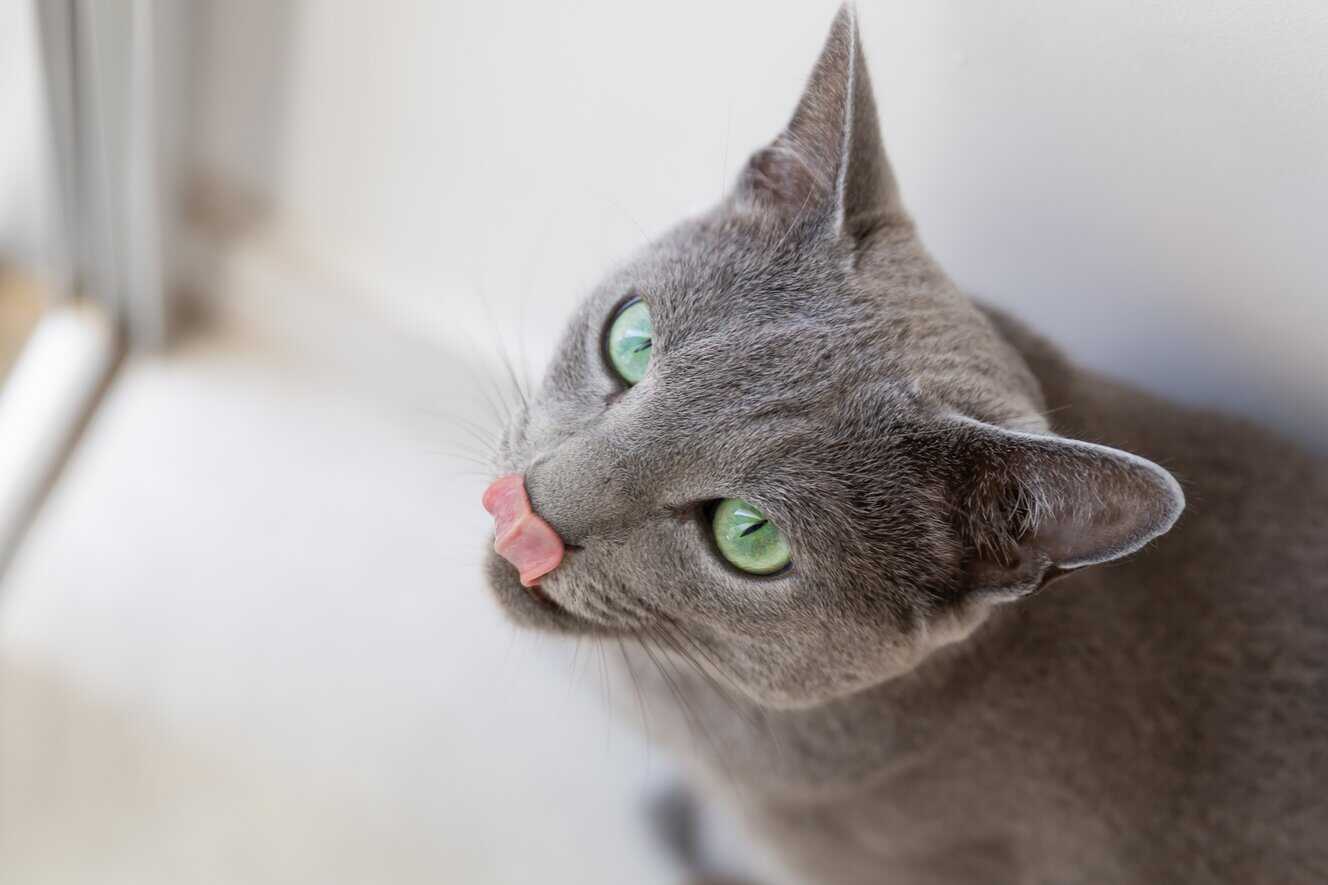
While Russian Blue cats may be the best-known variety, this elegant breed also comes in black and white. These medium-sized felines have a long, graceful body, long legs with small oval paws, a tapered tail and a short, wedge-shaped head with large, pointed ears and vivid green eyes.
Russians are renowned for their velvety double coats that have a soft texture and, according to feline experts, are very different from any other breed.
“The coat of the Russian is a very important feature, being short, thick but fine and standing up soft and silky,” says the GCCF. “The Russian Blue coat has a silvery sheen, the Russian Black has a glossy coat, while the Russian White coat appears to sparkle.”
“The silvery tip to the hairs reflects the light, and the coat shimmers like moiré silk as the cat moves. Watching a Russian Blue moving in sunlight is like watching poetry in motion!” raves TICA, adding: “The deep, vivid green eyes engage your attention and draw you deep into their depths. The enigmatic smile hovers on the face as the cat watches you, entranced with its regal bearing.”
WHERE DO RUSSIAN CATS COME FROM?
As with most cat breeds, the history of Russian cats is a bit of a mystery. “Although there is no definitive history of the origins of the breed, it has certainly been known about for at least the last 150 years,” says the GCCF. “It is generally accepted that the Russian Blue is a naturally occurring breed that originated from the Archangel Isles in northern Russia, and it is most likely that it arrived in England and northern Europe via ships travelling from that region. Many of the first Russian Blues were acquired from sailors, and it is documented that one, called Kola, was swapped for a leg of mutton in 1890 at the London Docks.”
ARE RUSSIAN CATS HYPOALLERGENIC?
It has been suggested that Russian Blue cats are hypoallergenic, but experts say this is not the case.
The Russian Blue Breeders Association states: “Despite claims online or in articles, magazines and books, Russian Blues are NOT hypoallergenic. If you are allergic to cats or have had a positive reaction to a feline allergy test, then you will also be allergic to Russian cats. Russian cats have a double coat and shed fur, dander and saliva the same way other cats do. If you are allergic to cats, please do not get a Russian kitten. It is not fair on the kitten when it needs to be rehomed or on yourself.”
Read on to find out more about Russian cats. Are they shy and aloof? Are they good with children and other pets? Are they playful and affectionate? What do Russian cats like to do? From grooming and playtime to feeding, find out how to provide Russian cats with everything they need to live a fulfilling and happy life.
But first, check out these Russian cat facts!
7 REMARKABLE RUSSIAN CAT FACTS
- Russian cats are medium in size. Adult females weigh between 7 to 10 pounds (3 to 4.5 kg), and adult males 10 to 12 pounds (4.5 to 5.5 kg).
- Russian cats are sometimes called Archangel cats – a name given to them after their point of origin – the Russian port of Arkhangelsk on the White Sea, about 150 miles south of the Arctic Circle.
- A Russian Blue was first displayed at one of the first cat shows at the Crystal Palace in London in 1875, where they were listed as the Archangel cat.
- Russian kittens are born with bright blue eyes, but as they mature, their eyes change colour. At around four months old, their eyes change to pale yellow, then deeper yellow, and then to bright green when they’re an adult.
- Russian cats are highly intelligent and need lots of mental stimulation, which means they can benefit from training, using positive reinforcement techniques.
- Russian cats have a combination of very fine bones and dense double-layered coats. So, although they have slim frames, their thick fur makes them appear larger and fluffier than they really are.
- Russian cats have such dense fur that you can draw patterns in their coat that will stay until you smooth them out again.
RUSSIAN CAT PERSONALITY PROFILE
Russian cats are renowned for sizing people up before deciding if they’ll make suitable friends. However, once you pass the assessment, they are playful, loving companions that get along well with children and other pets.
“It observes people to determine if they are worthy of its companionship,” notes the GCCF. “Sometimes people see this behaviour as shy or aloof when it is really a reserve with strangers until it has fully assessed them. Once the Russian decides you are worthy of its attention, it is extremely affectionate and expects your loving attention to all its needs.”
“They are known for their friendliness and intelligence, but are somewhat reserved around strangers,” adds TICA. “However, they are affectionate and very close to their family and tend to follow them around, sometimes on their shoulders.”
Russian cats like to keep out of trouble
Their ability to assess people and situations means that Russians rarely get themselves in puzzling predicaments. “The Russian Blue surveys a situation before diving in and so rarely gets itself into a difficult situation,” says TICA.
And, given their high level of intelligence, this reticence is a very good thing. “Few other breeds can match the Russian Blue for sheer intelligence, and when it comes to mechanical aptitude, they are at the top of the list,” notes the CFA. “Every closed cabinet, every shut drawer, even sealed canisters or jars, represent a tempting challenge. Owners should never be surprised to find an unexpectedly open door, drawer or jar. It’s wise to divert their attention with intellectually stimulating puzzle toys as well as interactive games.”
Once they’ve made friends, Russian cats expect lots of affection
“Russian Blue cats are one of the most loyal breeds of cat you can own, and they often attach to one person in particular. However, this friendly breed will still expect love and affection from everyone in the home!” says Petplan. “The elegant and aristocratic Russian Blue is a sweet-tempered, loyal cat,” notes TICA. “They are loving companions who will seek out a spot on your lap or even ride through the house on your shoulder,” adds the CFA.
Understand your cat better with our cat communication guide >>
IS MY HOME SUITABLE FOR A RUSSIAN CAT?
Experts agree that once a Russian cat has warmed to you, they’ll become a loyal and loving companion who is happy in their own company but will give you a warm welcome when you get home.
“They are a great choice for the modern family because they are content with their own company while you are out and about, but delighted to spend time playing or curled in your lap when you get home,” says the GCCF.
“Easy to care for, easy to live with, Russians don’t need a lot of space to feel content, and while they may appear shy at first acquaintance, they quickly blossom into friendly, affectionate companions once they get to know you,” says the CFA.
“Intelligent and gentle, the Russian is an affectionate but undemanding companion. They are usually devoted to their owners, and this makes them especially suitable for older people or those living alone,” adds Your Cat. “For those who are at work during the day, your Russian will stay contentedly at home and be happy to greet you and spend time with you when you arrive back.”
“More than just looking beautiful, this breed makes wonderful companions. Typically, their behaviour is calm, shy, affectionate and playful,” says Petplan. “When your cat becomes familiar with you, they are a superb balance of social and loving. They don't mind too much if you're away at work for a little while – especially if they have plenty of interesting toys to entertain them. But when you return home, you’ll find them waiting to greet you by the door and ready for lots of love, affection, and play.”
An ideal cat for quiet, peaceful homes, who will get along with other pets
The insurer notes that these chilled cats thrive in a relaxing, restful home: “This breed makes for a wonderful family pet, but you do need to consider if your home is right for them. They need a peaceful home with regular routines. Young children or boisterous pets might be stressful.”
“They are good pets for older children, who will let the cat take its time feeling comfortable around them,” advises the CFA. “Russians are excellent family pets as they get on very well with dogs and most other cats,” adds Your Cat.
“Playful and loving companions, they get along well with children and other pets. They are content to be home alone and then happy to engage and interact with you when you return home, making them well-suited to apartment living,” says TICA.
“They're very elegant and graceful, generally very calm and good companions,” adds breed expert Elisabeth Stark. “They might be shy when they are with strangers, but they are very home-loving and get very attached to their humans.”
WHAT DO RUSSIAN CATS LIKE TO DO?
While every cat is an individual with a unique set of likes and dislikes, there are certain things that are extremely important to Russian cats.
Top of the list is hanging around with their human family, a regular routine, joining in with everyday activities, and playing lots of games together. They also like to chat with their human.
“While generally quiet cats, they will talk to you if you talk to them and develop a large vocabulary. Observant and persistent, Russian Blues can be very vocal and will use their voice to converse back-and-forth and communicate with others,” says TICA. “They thrive on structure and expect you to maintain a regular schedule – although they will try to convince you that you are late with a meal or to pretend to another family member that you forgot to feed them!”
“Very sensitive to their owners’ moods, Russians will clown around in an attempt to cheer you up or offer gentle purrs and head butts to a crying child,” adds the CFA.
Intelligent Russian cats need lots of stimulation
“Smart and observant, they can be taught to play fetch and do tricks, including how to open doors and drawers. Challenge their brain by teaching them tricks and providing puzzle toys that will reward them with kibble or treats when they learn how to manipulate them,” advises TICA. “They are especially fond of retrieving, jumping, and climbing to high places where they can study people and situations before making up their mind about whether they want to get involved.”
“Training your Russian Blue to do tricks, using positive reinforcement techniques, is also a good idea. Clicker training is a great option and not only provides mental enrichment but also strengthens the bond between human and cat. Russian Blue cats need a lot of exercise and mental stimulation,” says Petplan. “Always keep a range of interactive toys available for your cat, especially if you’re out of the house. Because of their energetic, muscular bodies, they love to pounce and catch. If you can create play opportunities for them to use their hunting instinct, they’ll be extra satisfied.”
The insurer recommends having cat trees with lots of climbable surfaces in your home, allowing your cat to exercise, adding: “Additionally, they will love to explore outside, so providing a secure outside space or ‘catio’ will give them a chance to burn off some of their energy.”
And, after some energetic playtime, Russian cats will seek out a safe, undisturbed place for a snooze. “While very social, they also enjoy alone time and will seek a quiet, private nook to sleep,” says TICA. “They feel more comfortable in a quiet, peaceful spot where they’ll be left alone, so make sure they have access to choices: high and low, safe, secure places to hide away,” adds Petplan.
GROOMING YOUR RUSSIAN CAT
When it comes to grooming, Russian cats manage to keep themselves looking good without much help from their human – although they do enjoy the attention!
“Like most shorthair breeds, the Russian cat does not require much grooming to keep the coat healthy, but they do love attention and brushing with a soft brush will be enjoyed,” says the GCCF.
“Russian Blues require minimal grooming if you maintain a good hygiene routine. Brush their coat regularly. This will also remove dead hair and distribute skin oils,” advises TICA. “Wipe the corners of the eyes with a soft, damp cloth to remove any discharge. Use a separate area of the cloth for each eye so you don’t run the risk of spreading any infection.”
“Russians are low-maintenance cats and tend to keep themselves looking immaculate. However, loose hair should be carefully combed out, and to enhance the silky sheen, the coat can be buffed with a chamois leather or silk scarf,” notes Your Cat. “Be careful not to overgroom, which will remove some of the plushiness from the coat and make it appear flat. The large ears should be inspected once a week, and carefully cleaned with damp cotton wool if they are greasy.”
The ultimate cat grooming guide >>
FEEDING YOUR RUSSIAN CAT
All cats – from tiger to domestic tabby – are obligate carnivores, which means they must eat meat to survive. Meat contains essential amino acids which they can’t make themselves. Cats also require high levels of protein and can benefit from food that’s appropriate for their life stage.
Industry body UK Pet Food states: “Cats vary from many species, requiring a significant amount of protein in their diet, plus certain nutrients, such as taurine, as part of a balanced diet with just the right amount of fats, carbohydrates and essential vitamins and minerals, to stay in peak condition. Nutrients must be present in the correct amounts for their stage in life and in the correct proportion to each other, in order to provide a nutritionally complete and balanced diet.”
Burgess in-house vet Dr Suzanne Moyes MVB, MRCVS advises: “Along with high protein levels, cats require a careful balance of vitamins, plus the essential amino acid taurine necessary to promote a healthy heart and eyes. A complete diet will have all the necessary vitamins, minerals, essential fatty acids and amino acids in the right ratio.”
How much and how often should you feed your cat?
Adult cats are generally fed twice a day. Alternatively, as cats in the wild naturally eat lots of small meals per day, you could try splitting their daily intake into several small meals (unless advised otherwise by your vet). Providing dry cat food in a variety of ways, such as in treat balls or cat puzzles, can deliver a much more exciting and rewarding experience for your cat.
Portion control is also important, so get into the habit of measuring out accurate amounts each day. Giving your cat a little more than they need means they could become overweight. Likewise, if you don’t feed enough, your cat will not get all the nutrients they need and will become underweight.
Don’t be fooled by requests for extra food
“Russian Blues are known to have a healthy appetite. It is important to make sure they don’t overeat by keeping them on a regular feeding schedule and avoiding too many cat treats,” advises TICA.
“Russian Blue cats can be very chatty and vocal with their owner, which can be interpreted as hunger or requesting food. If you know your cat is well fed, and you are feeding them the recommended amount on the food packaging, resist the temptation to feed them more. Be aware that Russian Blue cats are prone to obesity and tend to have big appetites,” says Petplan. “This breed typically has a small frame, which means they can be seen as underweight when in fact they’re perfectly healthy. If you’re ever concerned by their size or appetite, make sure you discuss this with your vet.”
Dr Moyes adds: “By following the on-pack instructions, it’s easy to measure out exactly the right-sized portion that’s suitable for your cat’s age and lifestyle to ensure they consume the correct amount of nutrients. For instance, house cats may need fewer calories than cats who spend much of their day roaming outdoors. Dry cat food is a good option as it’s easily portioned, may be better for dental health and encourages extra water consumption.”
Wet food v dry food
Unlike wet cat food, dry cat food stays fresh inside the pack until you’re ready to serve it to your cat. And that’s not all! Other benefits include:
- Free feeding – As dry food can be left out because it won’t spoil, this suits those cats who prefer to graze their food over the day rather than at specific mealtimes.
- Helpful for healthy teeth – Munching on crunchy kibble encourages chewing and helps to keep teeth clean.
- Makes feeding more fun – Dry food is easier to use with food dispensers and puzzle toys, providing environmental enrichment and mental stimulation.
- Portion control – By following the on-pack instructions, it’s easy to measure out exactly the right-sized portion to help your cat maintain a healthy weight.
Make sure to supply plenty of fresh water, too, in a separate place from their feeding area. Lots of cats aren’t keen on drinking water from a bowl, preferring moving water to still – so it may be worth investing in a cat fountain if you don’t want them drinking from a dripping tap!
GETTING A RUSSIAN CAT
If you’re interested in adding one of these fabulous felines to your family, find out as much as you can first and decide if you’ll be able to provide them with everything they need to be a truly happy and contented cat.
“Welcoming your new cat into your home is an exciting time. Russian Blue cats can be cautious when meeting unfamiliar people, so introductions should always be done at their pace,” advises Petplan.
If you’re looking for a kitten, only ever buy from a reputable, registered breeder.
Alternatively, visit the Cat Rescue Resource or the Russian Blue Kittens for Rehoming & Adoption Facebook page to find beautiful rescue cats looking for happy new homes. Also check out other rescue charities such as Cats Protection, Battersea, Blue Cross, RSPCA and Woodgreen, who’ll be delighted to hear from you, and can provide you with lots of helpful advice on adopting a rescued cat.
EVERY CAT DESERVES A DELICIOUS, NUTRITIOUS DINNER!
At Burgess Pet Care, all our cat food is made using premium ingredients to ensure excellent quality and superior taste to help keep your cat happy and healthy – from kitten, to adult and mature and Burgess Neutered Cat with Chicken – an advanced, high protein, complete food with added L-Carnitine to help maintain a healthy weight.
- Salmon? Duck? Chicken? Let your adult cat pick their favourite flavour with our fussy cat bundle >>
- Our cat diet and nutrition guide is here to help you create a meal plan that's tailored especially for your feline friend.
- How often should you feed your cat? Find out why little and often suits most cats – and the reason why play should be part of your feeding routine.
- Adapting your cat’s diet throughout their life What you choose to feed your cat at different life stages can make all the difference.
CARE MORE Find out more about caring for your cat from Burgess, the Pet Care Experts.
Is your cat a Burgess cat? Join our Pet Club for exclusive offers and competitions – and expert advice from our in-house vet, Dr Suzanne Moyes.
If you found this interesting, you may also like:
CARING FOR KITTENS Discover how you can help your kitten get the very best start in life.
KITTEN TIMELINE – WHAT ARE YOUR KITTEN’S MILESTONES? When will my kitten eat solid food? When will my kitten start to purr? When will my kitten be able to go outside? Mark your meowing munchkin’s milestone moments with our comprehensive kitten timeline.
THE NEXT BIG STEP FOR YOUR LITTLE CAT When does your kitten become a cat? What changes will you see in their behaviour? When do you need to switch them over from kitten to adult cat food – and what are the nutrition differences that benefit them as they grow?
CATS – WHAT’S GOING ON DURING THE ‘TEENAGE’ PHASE? Is your young cat suddenly bursting with energy, wanting to play at weird times, and fiercely guarding their favourite hang-out spots before going off in a huff? It’s likely you have a ‘teenage kit’ on your hands.
A LITTLE EXTRA HELP FOR OLDER CATS When our beloved cats get older, it’s our job to make their life as comfortable as possible. Their fast-paced days of crazy kitten antics may be a distant memory, but they still possess the desire to exhibit their natural feline behaviours – they just need a little help from us.
CAN YOU TRAIN A CAT? Felines excel at training their human guardians to give them food, attention and a cosy lap to curl up on. But is it possible for us to train them?
ALL ABOUT RAGDOLL CATS Gentle, genial and generally laid-back about life, Ragdolls are the perfect choice if you long for a large, fluffy cat who will follow your every move and may even hide ‘finds’ in your shoes...
ALL ABOUT MAINE COON CATS Playful, loyal and surprisingly placid, Maine Coons make excellent companions for people who want to share their days with a big, furry cat with a gentle, affectionate nature.
ALL ABOUT BENGAL CATS Are Bengals friendly and affectionate? Are they active and playful? Do they really have glittery fur? Get all the answers in our guide to beautiful Bengal cats.
ALL ABOUT NORWEGIAN FOREST CATS Do Norwegian Forest cats need lots of space to play and explore? Are they affectionate lap cats or do they have a more independent nature? Find out in our guide to these fabulously fluffy felines.
ALL ABOUT BRITISH SHORTHAIR CATS Gentle, affectionate and independent, discover why super popular British Shorthairs have just what it takes to be the ideal family cat.
ALL ABOUT SIAMESE CATS If you’re looking for an outgoing, social cat that’s not shy to ask for attention and is affectionate yet independently minded, then a Siamese could be your ideal feline friend.
ALL ABOUT PERSIAN CATS Looking for a chilled-out feline companion who loves plenty of lap time? A Persian could be your perfect match.
ALL ABOUT BURMESE CATS If you’re looking for a shoulder-perching feline that wants to be at the heart of your world, then the Burmese could be your dream cat companion.
CAT BREEDS – TAKE A CLOSER LOOK AT SOME OF THE UK’S MOST POPULAR TYPES OF CAT Siamese or Bengal? Norwegian Forest or Maine Coon? Ragdoll or Russian Blue? Which breed of cat do you find most captivating? We count down 10 cat breeds that are riding high in the popularity charts, plus one favourite feline that’s not actually a breed at all…
PLAY WITH THIS – NOT THAT! HOW TO CHOOSE THE BEST CAT TOYS Cats love stalking things, chasing things, and exploring things with their paws and teeth, which can sometimes lead to a whole mess of trouble. Introducing a selection of feline-friendly toys will keep your pet entertained while ensuring they won’t come to any harm.
HOW TO HANDLE YOUR CAT Cats like to feel in control of whatever situation they’re in and are quick to show when they’re not happy. Never is this more evident when it comes to being handled when they don’t want to be.
DOES YOUR CAT KNOW THEIR NAME? Whatever name we choose to bestow upon our beloved pet cats, does it make any difference to them? Do they actually understand that they’re called Alfie or Bella or even Archibald von Snugglemuffin?
ARE YOU AND YOUR CAT MORE ALIKE THAN YOU THINK? If you have a grumpy Tabby cat, a super friendly Ragdoll cat, or fiendishly feisty Bengal cat, could this actually say more about you than your pet?
10 THINGS I HATE ABOUT YOU Super tidy house? Cleaning blitzes? Cuddle overload? If our feline friends could tell us what they really think, here’s what they’d probably say about some of the things we do that they’re none too happy about…
WHEN SHOULD YOU NEUTER YOUR CAT? As well as preventing unwanted pregnancies, neutering benefits your favourite feline’s health and wellbeing in all sorts of ways. In fact, feline experts believe it’s the kindest thing you could do for your cat.
HOW TO TELL IF YOUR CAT REALLY LOVES YOU While you may adore your captivating cat, how does your enigmatic feline companion feel about you?
MUSIC TO THEIR FURRY LITTLE EARS? What’s on your playlist? Cat Stevens? The Stray Cats? The Pussycat Dolls? And have you ever wondered if your cat appreciates your taste in music, or would they prefer music created especially for them? Yes, it’s a thing!
PLAY BEHAVIOUR OF CATS SURPRISES SCIENTISTS While there are lots of things that cats do which cause scientists plenty of head-scratching moments, new research into the way that cats play has resulted in some rather baffled boffins...
THE EYES HAVE IT When it comes to the mysterious task of understanding cat language, focusing on one of a feline’s most appealing features – their captivatingly beautiful eyes – could be the key.
SHOULD LILIES CARRY A HEALTH WARNING? Did you know that lilies are so poisonous that a cat can suffer fatal kidney failure just from nibbling a leaf, licking pollen off their coat or even from drinking water from a vase with cut lilies in it?
DOES YOUR CAT RECOGNISE YOUR HAPPY FACE? How do cats see humans? Do cats recognise faces? Do cats remember people? Do cats miss their owners? Do we own cats or do cats own us?
IS YOUR CAT REALLY MAD AT YOU? Whether it’s because you’ve had to take them to the vet, or you accidentally stepped on their tail, your cat may give you the impression that they’re really cross with you. But can cats really hold grudges?
MY CAT IGNORES ME – WHY? Unlike dogs, who generally want to be involved in every situation, cats are known for being independent. While some cats can be quite social, it can be hard to take when your favourite feline seems to take absolutely no notice of you. So why is this the case?
GIRLS V BOYS – FELINE MYTHS AND MISCONCEPTIONS Do male and female cats act differently because of their gender? Are generalisations about laid-back, lap-loving boys and aloof, independent girls simply myths – or is there any truth to them?
THE HOMING INSTINCT – CAN CATS REALLY FIND THEIR WAY HOME? Top tip – it’s much easier if they’re microchipped! Plus, what a change in the law means for every cat owner…
Featured products

Adult Cat Bundle
from £22.48 — or subscribe to save 5%
Blog categories

Dogs

Cats

Rabbits

Guinea pigs