
You’ve settled your new puppy in, and they’re feeling comfortable and confident in their new home. What’s next? Along with mastering toilet training (which can take a while!), socialisation and habituation are next on the list. Help your puppy’s adventures get off to a great start with our expert hints and tips.


Expert approved
Dr Suzanne Moyes MVB, MRCVS
8th May 2026
The world is a strange, exciting and bewildering place for puppies who have to figure it all out with the help and support of their trusted human companion. It’s no wonder that puppyhood can be a challenging time for everyone involved.
“Puppies need to learn how to live among people, other dogs and any other animals they are likely to meet, such as cats and livestock. How sociable and well-adjusted they will be is also determined by their experiences, especially before the age of 12 weeks. This is the most important period in which to expose them to all the things that we will expect them to consider normal and safe when they become adults,” advises animal wellbeing charity Blue Cross.
Keep reading to find out more about:
- How to introduce your puppy to the world successfully
- Understanding the importance of socialisation and habituation
- Managing encounters with other dogs
- Handling your puppy so it’s a positive and fun experience
- Why training is the key that unlocks the special relationship with your dog
HOW TO INTRODUCE YOUR PUPPY TO THE WORLD SUCCESSFULLY
As puppies aren’t allowed to walk about outside (except in your garden) until they’ve completed all their vaccinations, which protect them against a range of diseases, you’ll need to carry them around with you (until they’re around 12 weeks old). This ensures that they can begin to experience the sights, sounds and smells of the world around them in a positive, safe way.
“Things that they don't encounter during this time may be treated with fear and caution in later life, so it is extremely important to use this time as effectively as possible,” says Blue Cross. “This time is absolutely crucial to help the puppies learn about new positive experiences.”
Improve Veterinary Education, a veterinary postgraduate training and education organisation, advises: “They can still experience the world from the safety of their owner’s arms. If owners prefer, they may consider using a carry bag/papoose instead, although it is important that the puppy is introduced to this carefully and does not find this stressful.” The organisation has these top tips:
- Carry the puppy around local walking locations, such as woods, beaches, heathland or by the road, thus exposing them to different environments and traffic
- Sit at a dog-friendly pub or café
- Visit a garden centre or the local pet shop
- Go to the veterinary practice for some treats
- Take them to places in the car so that the puppy can sit in the boot and watch the world go by. This might be at a supermarket (watching lots of people and trolleys pass by), near the local train station, to listen to the trains or perhaps going to the local playing fields when children are playing football
“Owners should be advised that puppies tire easily, so it is important that these experiences and encounters are kept short and sweet, with plenty of time to rest, adds Improve Veterinary Education.
UNDERSTANDING THE IMPORTANCE OF SOCIALISATION AND HABITUATION
“Puppy socialisation and habituation are two essential factors that contribute to their overall wellbeing,” advises dog training service Canine Evolution. “Socialisation involves introducing a puppy to different experiences, people, animals, and environments, while habituation is the process of getting a puppy used to certain stimuli and situations.”
And, of course, each puppy is an individual, which will have an impact on how they react to new experiences.
“Socialisation is key to a puppy’s development, but introductions should be slow and calm. You should always be on your guard if people approach your puppy to say hello,” says rehoming charity Woodgreen’s Dog Behaviour and Training Specialist Sue Ketland. “For shy puppies in particular, spontaneous attention from strangers could make your dog fearful of others later in their life. Confident puppies, on the other hand, may lavish all the fuss, and your dog may end up being more interested in other people than you.”
Puppies also need to learn to accept all the things they encounter outside – from traffic and livestock to cyclists and joggers. “This is called ‘habituation’, and it’s just as important as socialisation,” adds Sue Ketland. “It’s a good idea to habituate your puppy to other dogs and people, too, that way they’ll know to check in with you for a treat rather than chasing after everyone and everything.”
MANAGING ENCOUNTERS WITH OTHER DOGS
Feeling confident around other dogs and learning how to behave appropriately is an important life skill for all puppies who, depending on their personality, may be shy and back away, or attempt to jump and nip at unfamiliar canines in an attempt to get them to play.
“Owners should be encouraged to let their puppies interact with fully vaccinated dogs in a private garden, advises Improve Veterinary Education. “The importance of ceasing interactions if they become overwhelming should be highlighted. A bad experience with another dog during this developmental stage can often be worse than a lack of exposure.”
“Once your puppy is able to meet other dogs, always ask owners before you allow your puppy to approach, as it’s really important that their experiences are as positive as possible during their socialisation period,” adds veterinary charity PDSA. “Keep your puppy close to you and on the lead when doing introductions, and watch the other dogs’ body language to make sure they’re happy to greet your pup!”
Rehoming charity Battersea recommends using the ‘three-second rule’ for introducing dogs to each other. “Count to three as the dogs sniff each other, say thanks or nice to meet you to the owner, and then excitedly call your dog away and continue your walk. Keep praising your dog for walking away with you and reward them with a tasty treat for coming away from such a tempting distraction! By keeping interactions short, you can make sure the experience stays positive for both dogs.”
HANDLING YOUR PUPPY SO IT’S A POSITIVE AND FUN EXPERIENCE
From vet visits to trips to the groomers, a dog that’s happy about being handled makes life easier for everyone.
Woodgreen recommends: “Every day, make it a positive experience for your puppy to be handled. Gently stroke your puppy all over. Buy a brush and groom your puppy on a daily basis so they’re used to being handled. Get them used to you picking up their feet, lifting their tail, looking in their ears and holding onto the scruff of their neck. Get them used to their lead or harness by taking them for walks around the house or garden.”
WHY TRAINING IS THE KEY THAT UNLOCKS THE SPECIAL RELATIONSHIP WITH YOUR DOG
Training is essentially about how humans and canines communicate with each other. It’s how your puppy learns to safely and happily negotiate the human world. As dog guardians, it’s up to us to help our dogs learn when we’re happy to do certain things and when we’re not – otherwise, how else can they know what we expect from them?
However, training is not about issuing commands and expecting your dog to instantly react to them. The secret to successful training is mutual understanding. How can your canine chum do what you ask if he or she doesn’t understand what it is you’re asking?
Dogs Trust says: “Puppies aren’t born knowing how they’re expected to behave. This is why you may find some of their behaviours problematic. Don’t worry – this is normal, and puppies simply need to be taught in a careful and positive way. That way, they learn what they can and can’t do.”
Positive, reward-based training – which essentially is teaching your dog that nice things happen when they make good choices – is the best way to help both you and your puppy cope with common behaviour issues. Woodgreen’s Sue Ketland has these top tips:
- CHEWING – Puppies have sharp little gnashers, and since they explore the world through their mouth, it can be quite tricky for owners. Mouthing is very normal, and puppies do grow out of it. Keep offering them plenty of toys, and they’ll soon learn there are more appropriate things to take their frustration out on. Make sure there’s always a reward for them when they get it right. If distraction isn’t working, leave them in the room or take them to their puppy pen for a minute or two. This will let them know you won’t play when they’re behaving that way. For the ankle biters who grab slippers or tug on trouser legs, we advise owners to wear house wellies – yes, really! This way, your puppy won’t be able to hurt you, so stand perfectly still, and they’ll soon realise that it’s boring.
- DESTRUCTIVE BEHAVIOUR – Puppies chew. It’s what they do! So, it’s a case of preventing them from grabbing things within their reach. Have a tidy up and puppy-proof your home. Keep all valuable items out of reach, and make sure you don’t leave any potentially harmful foods on the coffee table, like grapes or chocolate. If you’re not a naturally tidy person, one of my tricks is to ‘hidey up’ rather than tidy up – keep a lidded plastic box in every room and pop any loose items in there. During times when you can’t keep an eye on your puppy, keep them inside a puppy pen with an open crate, water, some toys and enrichment feeders to keep them busy. We recommend Kongs, LickiMats or homemade alternatives like stuffed toilet roll tubes. It’s worth rotating their toys to keep them interested – puppies can get bored very quickly.
- GUARDING – The trick is to add, never take away. By taking your dog’s food bowl away and giving it straight back, you’re likely to upset them. A good idea is to put half of your puppy’s food in the bowl, then call their name as they’re eating and add more to the bowl. They will learn that when a hand comes down, more food comes, and there’s nothing to be wary of. Puppies are likely to steal items from around the house, too. Even if you’re tidy, they’ll get hold of something like a sock or a dropped tissue. If you react loudly and chase them to get the item back, they’ll think that’s a game. You might get away with taking things out of a puppy’s mouth, but when they’re a bit older, they’re likely to tell you to stop. If the item they’ve stolen is completely harmless, like a tissue, ignore it and don’t add any value to it. If it’s something you need to get back, swap it with something better, like a toy or a treat.
- ZOOMIES – It’s very common for puppies to get the ‘zoomies’, or have a ‘mad half an hour’, usually later in the day after they’ve eaten. Some people find this quite worrying, as their angelic puppy is now a whirlwind of energy, ricocheting off the furniture and nipping their ankles! In most cases, it’s caused by having excess energy or being over-stimulated. They will usually tire themselves out quite quickly, and they should grow out of it.
FEED YOUR PUPPY PREMIUM PUPPY FOOD WITHOUT THE PREMIUM PRICE!
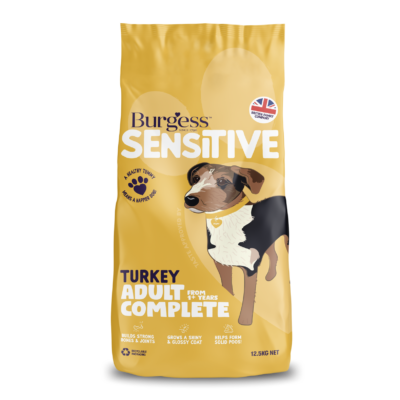
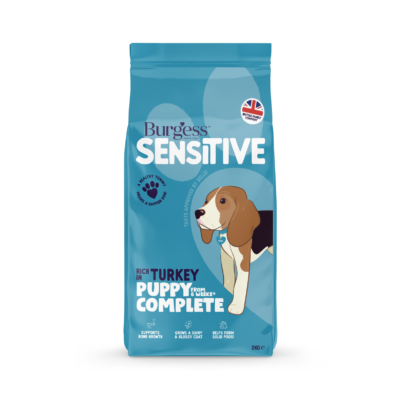
Burgess Sensitive Puppy has been developed by vets for puppies from 6 weeks to 12 months. This high-quality, complete, nutritionally balanced food contains everything puppies need to thrive. Rich in turkey for protein, with rice as an easily digestible source of carbohydrate and fibre, Burgess Sensitive Puppy Food is made without ingredients that can typically cause upset tummies and runny poos. Our tasty, hypoallergenic recipe features highly digestible protein to support growing muscles, and calcium and minerals to support developing bones and teeth.
Suitable for all breeds, our unique recipe includes:
- 30% protein to support developing muscles
- Calcium and minerals to support bone growth and healthy teeth
- Essential vitamins to support skin health and a glossy coat
- Antioxidants to support developing immune systems
- Prebiotics to support good bacteria in the gut
- Yucca, a traditional medicinal plant that helps make poos less smelly
- Highly digestible ingredients to support digestive health and help form solid poos
- No artificial flavours, colours or added preservatives
- Smaller nuggets, specially created for puppy-sized mouths and teeth
BURGESS SPECIAL BUYS Order Burgess Sensitive Puppy Food online today and save 15% with Subscribe & Save!
GOOD TO KNOW
- COMPLETE NUTRITION Each of the recipes in the Burgess Dog Food range are complete, providing all the nutrients dogs require in the right proportions.
- PORTION CONTROL With dry food, it’s easy to measure out the right-sized portion to help your dog maintain a healthy weight.
- HEALTHY AND SAFE The thorough cooking process ensures that any harmful bacteria, such as salmonella, and viruses are destroyed, and the dry food stays fresh inside the pack.
- TEETH-FRIENDLY Dry dog food has the added benefit of exercising your dog’s chewing muscles and provides a mild cleaning effect on the teeth.
- MADE IN BRITAIN Crafted at Burgess Pet Care’s own factory in the heart of Yorkshire, Burgess Dog Food contains high-quality ingredients that meet stringent specifications, locally sourced wherever possible to support British farmers.
With a whole host of *5-STAR REVIEWS*, our customers have told us:
* “My very fussy puppy loves it!!” * “This has really settled my puppy's stomach down as she has such a sensitive tummy... have just ordered more.” * “I’m absolutely over the moon with this dog food. My dogs are so much happier on this food. Thank you.” * “This food has really helped firm up my puppy’s poop!!! Plus, she loves it!!!” * “Excellent puppy food for delicate tummies, great service!” * “Very happy, puppy enjoys the kibble and is always excited at mealtimes.” * “Works well for my puppy and has made a great difference to his digestive system.” * “My Lab puppy has a sensitive stomach, and this food is ideal for him.” * “Perfect purchase, delivery and product. Very impressed.” * “Stopped the soft poo and made it much easier to clean up!” * “Great puppy food, our dog loves it, and it’s a reasonable price. The subscription service is great too.” *“An excellent dog food, definitely a market-leading brand. My dog thrives on it, no upset stomach ever.” * “A leader amongst dog foods.” *
NEED MORE ADVICE?
If you’re at all unsure about the best way of feeding your dog or have any concerns about specific nutritional requirements, ask your local veterinary practice for advice. You can also call our expert team, available 9am-5pm, Monday to Friday, on +44 (0)1405 862241 who’ll be happy to help. Alternatively, use our online contact form to get in touch.
CARE MORE
Find lots of useful advice on caring for your dog from Burgess, the pet experts >> Is your dog a Burgess dog? Join the Burgess Pet Club for exclusive offers, competitions and expert advice from our in-house vet, Dr Suzanne Moyes.
Blog categories

Dogs

Cats

Rabbits
Guinea pigs