

Taking your puppy out for their first walkies is a milestone moment – but how long should these early strolls be? Does the five-minute rule apply to all puppies? Should you introduce your puppy to other dogs? How much exercise is enough, without being too much? Our expert tips and puppy exercise DOs and DON’Ts can help you figure it all out!


Expert approved
Dr Suzanne Moyes MVB, MRCVS
19th June 2026
The first time those little paws hit the pavement is an incredible moment. Suddenly, the world opens up for your young dog, who’ll be taking in every sight, sound and smell of their new surroundings. Walking with your canine chum and exploring the world together is something you’ll enjoy for years to come, so you want to make sure it gets off to a good start.
Excitable puppies are bursting with energy, and walkies is a great way to burn some of it off. However, it’s essential to handle these early ambles with care.
Getting the exercise balance right
“Regular exercise will help your puppy to become a strong, confident and fit adult, but it’s important to avoid over-exercising them while their bones are still forming,” advises veterinary charity PDSA. “Puppies that are exercised too much, or do too much high-impact exercise, are at risk of joint and bone damage, which can lead to conditions such as arthritis and hip dysplasia. However, limiting your puppy’s exercise too much could cause boredom, frustration and lead to behavioural problems.”
With puppies, size matters
Depending on whether your puppy is a small, medium or large breed will affect the rate at which they become fully mature. This influences the amount of exercise that’s suitable for them, so it’s best to ask your vet for advice.
“It’s important to know roughly how long your dog will be growing for, because until they are fully grown, their joints and growth plates will be at risk of damage if they do too much exercise,” says PDSA. “Most dogs are fully grown by one year of age, but larger breeds such as Greyhounds, Labradors, Dobermans and Great Danes can take as long as 18 months to two years to reach full size.”
“Big dogs take longer to reach maturity than smaller breeds, so (depending on breed) we recommend asking your vet, but as a guide, holding off on long walks until they are around 12 to 15 months old,” adds animal wellbeing charity Blue Cross.
“It’s crucial to balance the amount of exercise you give your puppy with allowing their growing bodies to develop correctly,” says insurer Petplan, which recommends beginning with one or two short walks a day. “Remember that puppies need far less exercise than adult dogs. That’s because their bones and joints are still developing. The soft growth plates on your puppy’s leg bones need time to harden, and over-exercising during this time may lead to musculoskeletal problems in later life.”
What about the 5-minute rule?
The 5-minute rule suggests that you should allow five minutes walking for each month of age, so, for example, a four-month-old pup could enjoy walks of 20 minutes at a time, once or twice a day. However, PDSA disputes this one-size-fits-all approach: “It’s important to know that there’s no scientific evidence behind this rule, and although it might work for some, it’s not appropriate for most puppies. The older your puppy gets, the more exercise they can do. Just remember to always keep an eye on them and encourage them to rest if they show signs of getting tired.”
“Every puppy is an individual, and the amount of exercise your puppy needs will depend on their breed. An active and energetic Border Collie puppy will likely need a lot more exercise than a laid-back Pug,” adds Petplan. “During walks, watch your puppy for signs of tiredness. If they sit down or start to struggle, cut back on the duration of your walks.”
Read on to find out how to plan your first walk, tips on handling it successfully, plus some useful puppy exercise DOs and DON’Ts...
BEFORE YOUR FIRST WALK
- Wait until your puppy has completed their course of vaccinations – your vet can advise you when they’re fully protected, and it’s safe for them to be outside your home and garden.
- Ensure your pup has been out and about, with you carrying them, so they’ve had some early socialisation (getting them used to different experiences, people, animals, and environments) and habituation (so your puppy learns to accept all the things they encounter outside – from traffic and livestock to cyclists and joggers).
- Make sure your puppy has a correctly fitted collar with a name tag and is microchipped so they can be identified if they ever get lost while you’re out.
- Get your pup used to wearing their walking kit by introducing it slowly, letting them sniff and examine it before you gently put it on them, rewarding them throughout the process with lots of praise and treats. Blue Cross advises: “We recommend using a standard lead that attaches to a harness so that if they pull, there is no discomfort to their neck. A standard, non-retractable lead will mean your puppy stays close to you, giving you more control over your puppy, and won’t have the unintended consequence of teaching them to pull on the lead.”
- Practise walking with the harness and lead around your garden or in the house. “Being on a lead can be a strange and new experience for your puppy, so we need to help them understand that it is a safe and positive thing,” says Dogs Trust. “Start by teaching your dog that being close to you is a good thing by rewarding them for standing or sitting by your side.”
- Plan your route. “Pick a familiar route that you know is short and quiet. That way, you can ensure that the new experience is controlled and positive,” adds Dogs Trust. “This avoids too many other people, dogs, traffic and sounds that could be too much and make them worried on their first walk.”
ON YOUR WALK
- Don’t worry if your puppy doesn’t walk calmly. They’re likely to be excited, nervous, and a little bewildered by all the new sights, sounds and smells around them. “The only aim on their very first walk is to ensure that it is a positive experience that helps to build their confidence,” advises Dogs Trust.
- Let your puppy stop and sniff. “Puppies will get just as much out of having a slow potter around a field or park to stop and sniff all the exciting smells!” notes Blue Cross.
- Let your puppy set the pace. “Allow them to take their time and don’t pressure them to move on. They are learning, discovering and exploring the world around them,” says Dogs Trust.
- Decide how you will deal with other dogs. “You may wish to let your pup say hello to other calm and polite dogs, but bouncy, excitable or out-of-control dogs may worry your pup. Watch out for who’s up ahead, and if you’d rather your pup didn’t say hi to the approaching dog, simply turn and walk away. Try not to panic and pick your puppy up (unless you need to remove them from danger) as this may teach them to be fearful of dogs,” advises Blue Cross.
- Let your puppy choose if they want to say hello to people. “Give your puppy the choice whether they want to say hi or not. If your pup shows interest by walking towards the person, ask the person to gently stroke your pup’s shoulder and stop if your pup wants to stop,” recommends Blue Cross.
- Take plenty of your puppy treats with you. “Your puppy will have a lot of treats while you are training them. This is a great way to make sure it is a positive experience and will reinforce the behaviours,” advises Dogs Trust. “However, it’s important to make sure you reduce meal sizes to compensate for the large volume of treats.”
PUPPY EXERCISE DOs AND DON’Ts
- DON’T encourage high-intensity activities such as running, jumping up and skidding. Excessive ball chasing can also put a strain on growing joints.
- DO let your puppy run around freely at their own pace at home and in your pet-proofed garden.
- DO enjoy plenty of low-impact play activities such as gentle tug-of-war, short loose-lead walks, and safe, free roaming in enclosed areas where they can take a break whenever they feel pooped out.
- DO build your puppy’s walking stamina gradually, and if they get tired on a walk, stop to let them rest until they’re ready to trot off again.
- DO teach your pup some basic commands: “This is a great way to keep their mind stimulated and can be just as tiring as playing/going for a walk. Remember to keep sessions short and enjoyable and let your pup rest once they’ve had enough,” says PDSA.
- DON’T take them out for a run with you until they’re fully grown because it’s far too intense an activity for their growing bones.
- DON’T forget the importance of feeding a high-quality puppy food. “Feeding your puppy a healthy diet is just as important as exercise when it comes to their growing bones,” advises PDSA.
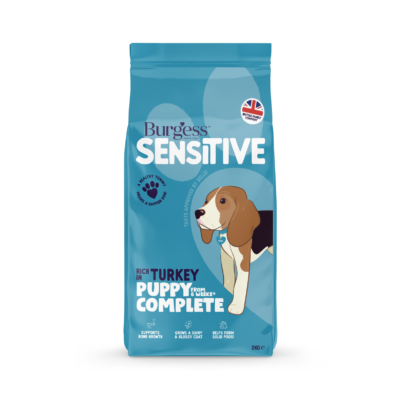
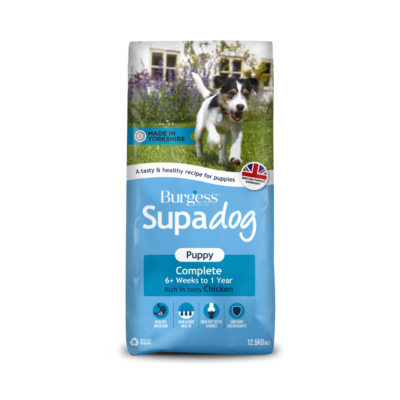
FEED YOUR PUPPY PREMIUM PUPPY FOOD WITHOUT THE PREMIUM PRICE!
Burgess Sensitive Puppy has been developed by vets for puppies from 6 weeks to 12 months. This high-quality, complete, nutritionally balanced food contains everything puppies need to thrive. Rich in turkey for protein, with rice as an easily digestible source of carbohydrate and fibre, Burgess Sensitive Puppy Food is made without ingredients that can typically cause upset tummies and runny poos. Our tasty, hypoallergenic recipe features highly digestible protein to support growing muscles, and calcium and minerals to support developing bones and teeth.
Suitable for all breeds, our unique recipe includes:
- 30% protein to support developing muscles
- Calcium and minerals to support bone growth and healthy teeth
- Essential vitamins to support skin health and a glossy coat
- Antioxidants to support developing immune systems
- Prebiotics to support good bacteria in the gut
- Yucca, a traditional medicinal plant that helps make poos less smelly
- Highly digestible ingredients to support digestive health and help form solid poos
- No artificial flavours, colours or added preservatives
- Smaller nuggets, specially created for puppy-sized mouths and teeth
BURGESS SPECIAL BUYS Order Burgess Sensitive Puppy Food online today and save 15% with Subscribe & Save!
GOOD TO KNOW
- COMPLETE NUTRITION Each of the recipes in the Burgess Dog Food range are complete, providing all the nutrients dogs require in the right proportions.
- PORTION CONTROL With dry food, it’s easy to measure out the right-sized portion to help your dog maintain a healthy weight.
- HEALTHY AND SAFE The thorough cooking process ensures that any harmful bacteria, such as salmonella, and viruses are destroyed, and the dry food stays fresh inside the pack.
- TEETH-FRIENDLY Dry dog food has the added benefit of exercising your dog’s chewing muscles and provides a mild cleaning effect on the teeth.
- MADE IN BRITAIN Crafted at Burgess Pet Care’s own factory in the heart of Yorkshire, Burgess Dog Food contains high-quality ingredients that meet stringent specifications, locally sourced wherever possible to support British farmers.
With a whole host of *5-STAR REVIEWS*, our customers have told us:
* “My very fussy puppy loves it!!” * “This has really settled my puppy's stomach down as she has such a sensitive tummy... have just ordered more.” * “I’m absolutely over the moon with this dog food. My dogs are so much happier on this food. Thank you.” * “This food has really helped firm up my puppy’s poop!!! Plus, she loves it!!!” * “Excellent puppy food for delicate tummies, great service!” * “Very happy, puppy enjoys the kibble and is always excited at mealtimes.” * “Works well for my puppy and has made a great difference to his digestive system.” * “My Lab puppy has a sensitive stomach, and this food is ideal for him.” * “Perfect purchase, delivery and product. Very impressed.” * “Stopped the soft poo and made it much easier to clean up!” * “Great puppy food, our dog loves it, and it’s a reasonable price. The subscription service is great too.” *“An excellent dog food, definitely a market-leading brand. My dog thrives on it, no upset stomach ever.” * “A leader amongst dog foods.” *
NEED MORE ADVICE?
If you’re at all unsure about the best way of feeding your dog or have any concerns about specific nutritional requirements, ask your local veterinary practice for advice. You can also call our expert team, available 9am-5pm, Monday to Friday, on +44 (0)1405 862241 who’ll be happy to help. Alternatively, use our online contact form to get in touch.
CARE MORE Find lots of useful advice on caring for your dog from Burgess, the pet experts >>
Is your dog a Burgess dog? Join the Burgess Pet Club for exclusive offers, competitions and expert advice from our in-house vet, Dr Suzanne Moyes.
Blog categories

Dogs

Cats

Rabbits

Guinea pigs