
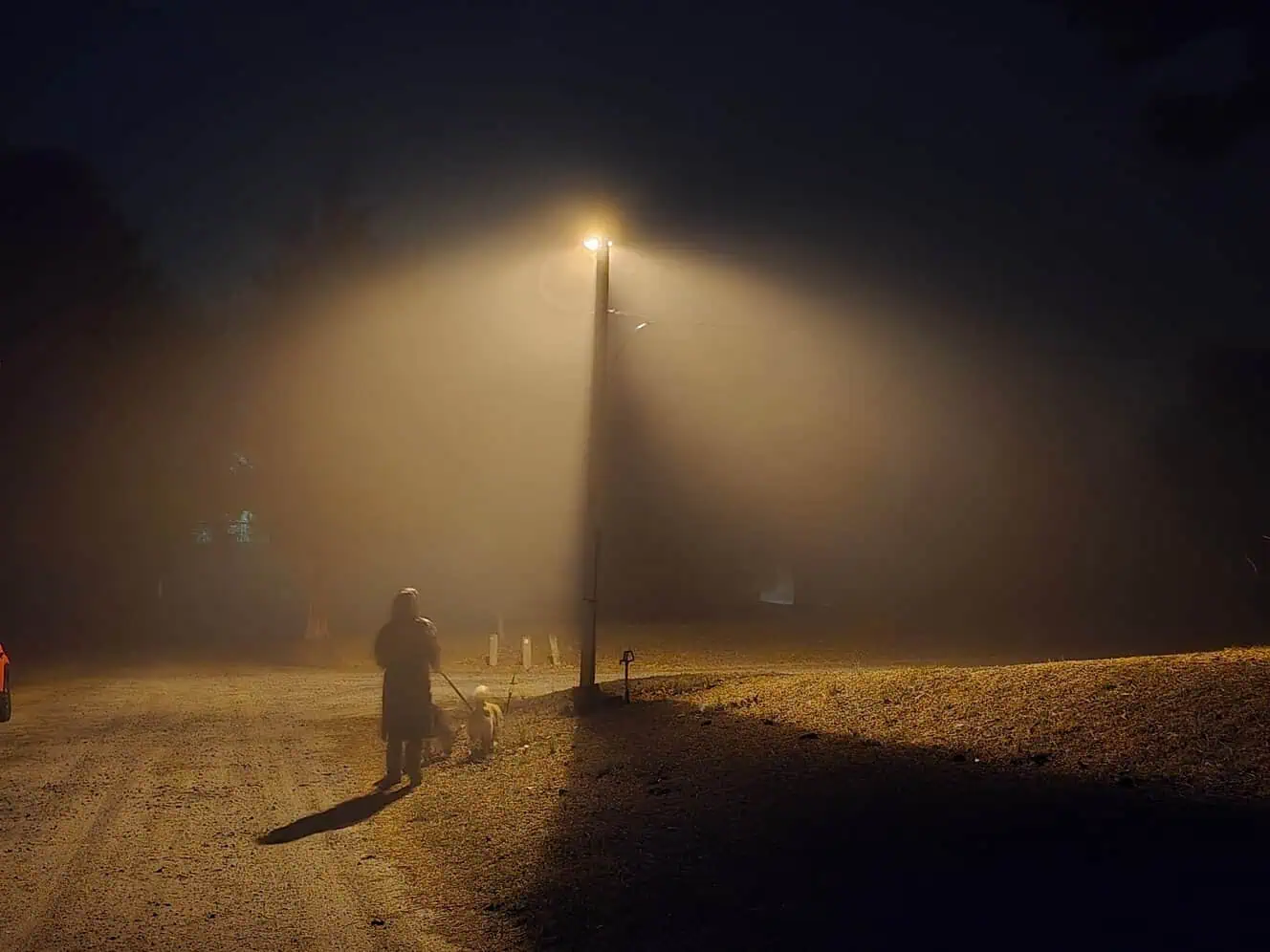
What gear do you need for walking your dog safely in the dark? What do the Highway Code regulations say about walking in low light? Is it ever safe to let your dog off lead? What’s the best way to handle encounters with other dogs? How can you help your dog if they get spooked on shadowy strolls? Our 7 top tips will help you navigate after dark dog walks like a pro!

Expert approved
Dr Suzanne Moyes MVB, MRCVS
3rd November 2026
Walking down an unlit alleyway you hear footsteps behind you, sense a shadowy presence approaching and detect panting breath around your ankles... it’s the stuff of nightmares until you realise it’s just one of your dog walking buddies who’s also ventured out after dark!
The final months of the year mean murky mornings and dim evenings, and, once the clocks have changed, many of us have no choice but to walk our dogs during the dark hours of spooky season.
And, while some canines consider this to be rather thrilling, others can find it a scary experience and need extra support. Dog walks in the dark also mean taking safety precautions to ensure that both you and your canine companion are safe.
Follow our 7 top tips for navigating dog walks in the dark successfully. Read on, as we’ll be covering:
1. Getting the right gear
2. Knowing the lead rules
3. Helping your dog to understand basic road safety cues
4. Choosing suitable walking routes
5. Ensuring your dog’s recall is reliable and giving other dogs space
6. Keeping a close eye on your dog’s body language
7. What to do when you’re both home and dry
1. Get the right gear so you’ll both be seen
Being visible in low light is not only sensible, but also advice set out explicitly in The Highway Code, which states: “Wear or carry something light-coloured, bright or fluorescent in poor daylight conditions. When it is dark, use reflective materials (eg armbands, sashes, waistcoats, jackets, footwear), which can be seen by drivers using headlights up to three times as far away as non-reflective materials.”
As well as wearing something reflective, carrying a torch is also essential to light your way. It will also enable you to see and pick up your dog’s deposits from the damp mush of autumn leaves, which is never an easy task! Better still, a head torch or clip-on light are great for dog walkers as they keep your hands free.
For your dog, there’s all sorts of after-dark kit available – from fluorescent coats and LED illuminated harnesses to reflective leads and light-up collars – which will help them stand out in the dark.
It’s also important that your dog is protected from cold wet weather with a waterproof, fleece-lined jacket. “A cold dog is an unhappy dog, so it's important to keep them as cosy as possible,” says Dogs Trust.
This is particularly important for very young or senior dogs, if your dog has health issues and for short-coated breeds such as Greyhounds, Whippets, Staffordshire Bull Terriers, Dobermanns and Weimaraners, as well as short-coated Dachshunds and Chihuahuas. Flat-faced breeds such as French Bulldogs, English Bulldogs and Pugs also need extra protection as they can struggle to regulate their body temperature efficiently.
However, putting a natty, weatherproof jacket on your dog may take a little practice if they’ve not worn one before. “Wearing a coat or light attachment is a new experience for some dogs and needs to be introduced in a gradual and positive way,” adds Dogs Trust. “This will help your dog enjoy wearing their equipment for winters to come.”
You also need to check that every piece of kit fits properly and is working as it should be. Ryan Neile, Head of Behaviour Services at Blue Cross, advises: “Always ensure collars, leads and harnesses are suitably sized, correctly fitted and are in good working order to prevent your dog breaking free and running away.”
And, while microchipping dogs from 8 weeks has been a legal requirement since 2016, so is having an ID tag. “Don't take your dog out if they don’t have a collar with ID: It’s a legal requirement for your dog to have a collar with an ID tag when out in public spaces,” notes the RSPCA.
For extra peace of mind, you could invest in a dog tracker. “Consider a tracking device to keep an eye on your furry friend's location,” adds vet, Dr Joanna Woodnutt MRCVS. “This is a simple way to add an extra level of safety to your evening walks.”
2. Know the lead rules
While extendable leads can come in handy as they allow your canine chum to explore a wider area while you keep control, which can be really helpful in the dark, be aware that the Highway Code advises that dogs should be kept “on a short lead when walking on the pavement, road or path shared with cyclists or horse riders.”
Veterinary charity PDSA adds: “The simplest step you can take to keep your dog safe near roads, is to keep them on a short lead attached to a well-fitted collar or harness. Don’t use an extender lead – it won’t give you the control you need if your dog suddenly dashes off or jumps into the road.”
So, while it may be a bit of a faff, it’s probably best to use a short lead until you reach an area where your dog can have a bit more freedom and then swap over to an extendable lead for some roaming time.
3. Help your dog to understand basic road safety cues
While you’ll always need to keep your dog under control to keep them safe around roads, teaching them to respond to some basic cues can help.
“Your dog won’t automatically know that they need to stop and wait at curb until it’s safe to cross – but you can help them to learn some road sense with simple commands such as ‘sit’ and ‘wait’,” advises PDSA.
“Teaching your dog to stop and sit at the edge of the pavement will help stop them rushing out in front of a car by accident. When you need to cross, walk to the edge of the curb with your dog close to you, ask them to ‘sit’ and give them a treat when they do. Then, tell them to ‘wait’ while you check if the road is clear. When it is safe to do so, calmly give your dog the command to ‘walk’ while you slowly cross the road. Don’t forget to use plenty of tasty treats – you want to teach your dog that it’s more rewarding to wait with you than it is to dash across the road!”
4. Choose suitable walking routes
Finding a walking route that’s illuminated by street lights is a good idea, for a number of reasons.
“Dogs see much better in the dark than us, but owners might feel safer walking in well-lit areas during the darker winter months so they can avoid hazards they can’t see well,” says Ryan Neile.
“It’s always a good idea to plan your route carefully – especially if it involves roads,” advises PDSA. “When crossing the road, it’s also a good idea to try to find marked pedestrian crossings to give you and your dog more time to cross safely. If there aren’t any crossings and you need to cross, try to avoid bends in the road, busy areas, or roads with a high speed limit.”
Pairing up with a dog owning friend or two is also a good idea. “Walking in groups is safer than on your own,” adds Your Dog. “Take your mobile phone with you and let someone know where you're headed. If possible, take your dog in the car to a place where you can walk away from the road; many parks and sports fields have lighting but always check that dogs are allowed.”
5. Ensure your dog’s recall is reliable and give other dogs space
If you can’t be certain your dog will come straight back to you when you call them, don’t risk letting them off the lead in the dark. The RSPCA says: “If you see another dog on a lead, ensure yours is, too.”
“Many owners will keep their dog on lead for various reasons such as training, reactive behaviour towards other dogs or people, nervousness or health reasons,” explains animal wellbeing charity Blue Cross.
Be aware that being on-lead can change your dog’s behaviour, which is why it’s always advisable to give other dogs you encounter some space. “When dogs approach each other on-lead, they have to meet each other head-to-head which may cause some dogs to become more worried/ frustrated than they would usually be,” adds Blue Cross. “It may help to give your dog plenty of space to pass other dogs so that they aren’t forced into greeting a dog that they don’t want to.”
“Meeting other dogs is more of an issue in the dark, so if your pet is nervous, it's probably best to keep them on a lead or within sight,” adds Vets Now. “Lively dogs may also attempt to jump over fences or walls and may be unable to see the depth or the drop on the other side, or other hazards like barbed wire.”
You know your dog best, so if they have a tendency to rush off to explore without a backward glance in your direction, it’s safest to keep them on lead in the dark.
6. Keep a close eye on your dog’s body language
Some dogs find walking after dark rather exciting, particularly as they can see far better than us humans, which means they may want a closer look at something they’ve spotted that we can’t see. This could result in some dramatic lead pulling that could catch you off guard.
“Dogs see much better than we do in low light for a number of reasons. Their pupils are bigger so let in more light, they have more rods in their retinas, and these are designed for low light. They have a tapetum behind the retina, which reflects light back again, so technically they see twice as bright,” explains Vets Now. “For those reasons don't take anything for granted when walking your dog in the dark. Your dog may spot something you don't and rush away in search of it. It's often those unexpected bursts of speed that lead to an accident.”
For other canines, walking in the dark can be a scary experience, particularly for those who are more sensitive to shadows, become alarmed by unexpected noises such as fireworks, or are spooked by the sudden appearance of other walkers with their dogs, joggers or cyclists.
Dogs communicate their discomfort through body language, so it’s essential to recognise the signs.
“Dogs can show us they are scared or uncomfortable in many different ways, ranging from tucking their tails between their back legs, crouching low to the ground, shivering, panting or licking their lips,” says Ryan Neile. “They might stop still and resist going towards something they are not sure about or even pull away in the opposite direction.”
“Some dogs don't mind the dark,” adds Dr Woodnutt. “Others dislike it, especially if they have anxiety. Old dogs with cognitive dysfunction may also struggle more with darker evenings. If your dog appears stressed by the dark, keep night walks to a minimum and do some indoor mental stimulation, instead.”
7. What to do when you’re both home and dry
Once home, a comforting towel down will be required and all ‘light up’ equipment needs to be removed and placed out of reach.
“Make sure you wipe your dog’s legs, feet and belly after a walk. Grit from the roads and dampness from rain or snow can irritate their skin,” advises Dogs Trust.
“Never leave light-up safety equipment on your dog after you return to the house, as they are often not made to the same safety standards as normal collars,” adds Dr Woodnutt. “In addition, light-up collars contain batteries and wires that can do your dog severe damage if they're chewed and swallowed.”
Here’s to happy dog walks, day and night, whatever the weather!
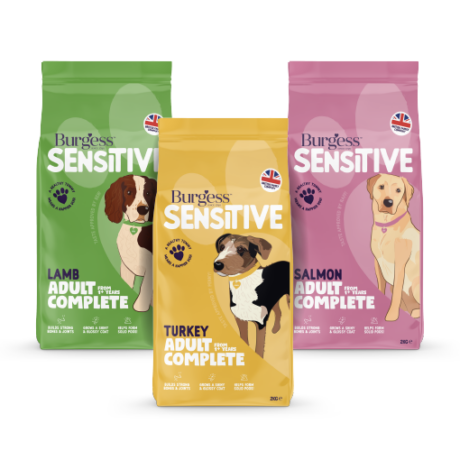
SOMETHING TASTY FOR EVERY DOG – PREMIUM DOG FOOD WITHOUT THE PREMIUM PRICE!
Every dog deserves a first-class dinner from puppy to adult and senior. Burgess Pet Care is a British, family-owned company, and all our dog foods are made using only ingredients that meet our stringent specifications. We’ve also developed foods to meet the specific nutritional needs of sporting and working dogs, Greyhounds and Lurchers and dogs with sensitivities.
GOOD TO KNOW
- COMPLETE NUTRITION Each of the recipes in the Burgess Dog Food range are complete, providing all the nutrients dogs require in the right proportions.
- PORTION CONTROL With dry food, it’s easy to measure out the right-sized portion to help your dog maintain a healthy weight.
- HEALTHY AND SAFE The thorough cooking process ensures that any harmful bacteria, such as salmonella, and viruses are destroyed, and the dry food stays fresh inside the pack.
- TEETH-FRIENDLY Dry dog food has the added benefit of exercising your dog’s chewing muscles and provides a mild cleaning effect on the teeth.
- MADE IN BRITAIN Crafted at Burgess Pet Care’s own factory in the heart of Yorkshire, Burgess Dog Food contains high-quality ingredients that meet stringent specifications, locally sourced wherever possible to support British farmers.
With a whole host of *5-STAR REVIEWS*, our customers have told us:
* “An excellent dog food, definitely a market-leading brand. My dog thrives on it, no upset stomach ever.” * “Our dogs just love it, and it keeps them happy.” * “Good value, wholesome food.” * “Edward (dog) is in raptures over this, he just can't get enough of it.” * “Our Ruby loves this food. In fact, she tries to open the food bin to steal it. That’s proof enough.” * “My dogs love it, it satisfies them, so it makes them happy and contented which makes me happy as they are thriving on it.” * “A leader amongst dog foods.” *
NEED SOME FEEDING ADVICE?
If you’re at all unsure about the best way of feeding your dog or have any concerns about specific nutritional requirements, ask your local veterinary practice for advice. You can also call our expert team, available 9am-5pm, Monday to Friday, on +44 (0)1405 862241 who’ll be happy to help. Alternatively, drop us a message.
CARE MORE Find lots of useful advice on caring for your dog from Burgess, the pet experts >>
Is your dog a Burgess dog? Join the Burgess Pet Club for exclusive offers, competitions and expert advice from our in-house vet, Dr Suzanne Moyes.
Blog categories

Dogs

Cats

Rabbits

Guinea pigs