
Do Dobermanns need lots of exercise? Are Dobermanns easy to train? Do Dobermanns need much grooming? Are Dobermanns good family dogs? Do Dobermanns bark a lot when left alone? Can they get on with other pets? Why are Dobermanns called ‘Velcro’ dogs? We have all the answers to your Dobermann questions!

Expert approved
Dr Suzanne Moyes MVB, MRCVS
20th October 2026
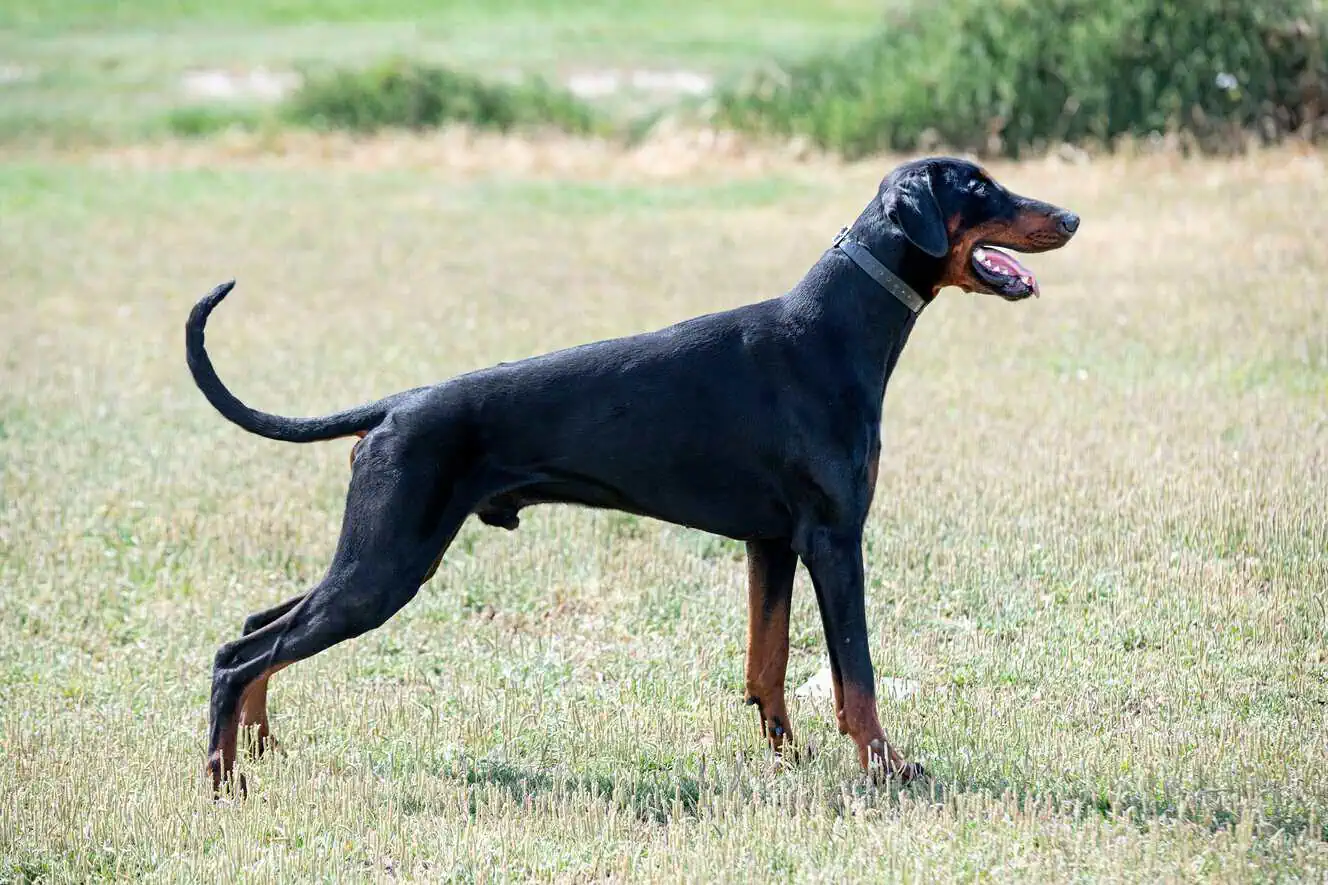
With their imposing demeanour and smart, sleek coat – which comes in black, brown or blue with rust red markings – Dobermanns are a breed that always cuts a dash. Renowned for their intelligence, trainability, and natural guarding instinct, these athletic, elegant dogs have a surprisingly loving and playful nature.
“Dobermanns are a large and powerful breed who love to be involved in everything their owners are doing. They’re loyal and intelligent which makes them popular pets,” says veterinary charity PDSA. “Although they were originally bred to be guard dogs, with an experienced owner, Dobermanns fit well into family life.”
With the right guidance, Dobermanns make loyal, loving companions
“The Dobermann is a highly intelligent working breed that forms strong bonds with its family,” adds Sue Ketland, Dog Behaviour and Training Expert at rehoming charity Woodgreen, who notes that their trainability and physical capabilities have seen them working closely with humans in the police and army for decades. “More recently, they’ve become more popular as pet dogs and, given the right guidance and exercise, make goofy and loyal companions,” she adds.
“The Dobermann’s large stature and loud bark can come across as intimidating but in reality, these dogs are generally friendly and crave companionship,” notes insurer Petplan. “Because of their specific needs and intensive training and exercise requirements, Dobermanns are best suited to experienced dog owners rather than first timers.”
What’s the best food for a Dobermann puppy? >>
Where do Dobermanns come from?
According to the Royal Kennel Club (RKC), the breed takes its name from the man who developed it – Louis Dobermann, a 19th century tax collector from Apolda, Germany – who wanted a dog to accompany him on his rounds and act as a deterrent to any would-be robbers.
The RKC reveals: “To a foundation of Pinscher blood was added Weimaraner, Greyhound, Manchester Terrier, Rottweiler and German Shepherd blood to get a combination of intelligence, speed and toughness of character. He has been used as a guard dog, a tracking dog and in various other roles. However, his loyal nature equips him to be an excellent family dog, a role in which he is equally comfortable.”
What’s the best food for Dobermanns? >>
Understanding what makes your Dobermann tick will help you give them everything they need to love life! Read on to discover more about:
- DOBERMANN PERSONALITY PROFILE
- IS MY HOME SUITABLE FOR A DOBERMANN?
- HOW MUCH EXERCISE DOES A DOBERMANN NEED?
- WHAT SHOULD I FEED A DOBERMANN?
- HOW MUCH GROOMING DOES A DOBERMANN NEED?
- WHAT’S THE BEST WAY TO TRAIN A DOBERMANN?
- GETTING A DOBERMANN
DOBERMANN PERSONALITY PROFILE
Dobermanns are high energy dogs who are incredibly affectionate with their human family but can take a while to warm up to strangers. If you can commit to plenty of exercise, training – and can spend most of your day with your dog – a devoted Dobermann could be your perfect canine companion.
Loyal, alert, protective, sensitive and bristling with energy – the Dobermann is a breed that requires a great deal of input from their human to guide them through training and socialisation – but all that effort will pay off. If you think a Dobermann could be the dog for you, it’s essential to understand their heritage and natural traits.
“Dobermanns were bred as protection dogs, so, they can be reserved around strangers and need to learn the right way to be around people and other animals when they’re young,” advises Sue Ketland.
“Dobermanns form strong bonds with their family and can be protective, so it’s important to socialise your dog with different experiences, people and dogs from a young age,” adds PDSA.
“They’re even nicknamed ‘Velcro dogs’ as they rarely want to leave their owner’s side,” says Sue Ketland. “They’re very playful and are happiest when they can spend some quality time goofing around with their favourite people and seem to forget how large they are, hopping up onto a lap for cuddles.”
Crate training a Dobermann puppy – make it their special place >>
Dogs Trust advises: “Just like you, every dog is an individual with their own personality and prior experiences. So, every Dobermann temperament is different. As dogs grow from puppies, they learn all about the world. They develop their own likes and dislikes and learn to respond to situations in different ways. For example, some dogs might like meeting other dogs, and some may not. Some might like new experiences, and others may need to go slowly.”
Want just YOUR dog to come when you call them? Choose their name wisely! >>
IS MY HOME SUITABLE FOR A DOBERMANN?
To create a perfect canine/human partnership, it’s vital to think about what kind of energy and temperament you’d like your four-pawed friend to have so you’re a good match for each other – and that you can provide a suitable environment. Dobermanns thrive best in homes with large, pet proof gardens where they can race around to burn off energy, and where someone is home most of the time.
“A Dobermann can be a great choice for an active family if the dog is taught how to be around people, especially children, from an early age,” says Sue Ketland. “They aren’t always comfortable with strangers, so they would be better off living in a rural or semi-rural environment rather than a busy city centre. If you have a busy household with lots of visitors, you need to be aware that this breed is naturally protective of property and its people. To keep everyone safe, it may be wise to install baby gates to ensure your Doberman cannot have access to unfamiliar visitors to the home.”
Dobermanns and barking
“As they were bred for guarding, you may find that your Dobermann is more vocal if someone new visits your home or if they think you need alerting of something unusual to them,” notes PDSA.
“They’re not known as a very barky breed, but Dobermanns will use their voices at home when their guarding instincts kick in,” adds Sue Ketland. “This could be when they hear people pass by, or when the doorbell rings, for instance. If a Dobermann has a problem being away from their owner, they’re likely to show stress or frustration by barking and/or howling.”
Dobermanns need company and don’t like being left home alone
This is a breed that needs companionship and doesn’t cope well when left to their own devices.
“Because they need lots of company and exercise, they aren’t the right breed for those who always work out of the house,” says Sue Ketland. “You can gradually build their confidence to spend time at home alone. This is an important step in making sure they don’t develop problems with you being away or they may show anxiety or attention-seeking behaviour, like barking to demand attention or stealing items.”
“As with any dog, your Dobermann should never be left on their own for more than four hours,” advises PDSA. “Because they get so attached to their owners, you might find that your Dobermann can’t even cope with this and may be destructive around the home to let you know they are unhappy. You may want to look for a dog-sitter or have a friend take care of your dog if you need to pop out.”
Dobermanns can be great companions for older children
Due to their size and energy, Dobermanns are best suited to families with older children.
“While they can make great family pets, due to their large size and strong build we wouldn’t recommend a Dobermann if you have young children,” advises PDSA. “You should always supervise your Dobermann with children and vulnerable adults as they often don’t know their own strength and may accidentally knock them over.”
Dobermanns and other pets
Experts agree that Dobermanns can live with other pets, although this is most successful when introductions are made at a young age.
“In general, Dobermanns can happily share their home with another dog, especially if they’re raised together and are opposite sexes,” says Sue Ketland. “They can live with other pets, too. But ideally, they need to be introduced to each other from a young age.”
“As long as your Dobermann is given enough time to socialise with other dogs from a young age, they should be fine with other dogs. You need to make sure this is consistent throughout their lives, as Dobermanns have a strong guarding instinct and may be wary of other dogs,” advises PDSA. “Dobermanns love any opportunity to chase smaller pets (which may include smaller dog when you’re out on walks, so keep a tight grip on the lead!). Never leave your Dobermann unsupervised with other pets.”
“A Dobermann’s affinity for cats will depend largely on your dog’s temperament and when they are introduced to any other pets. In general, though, Dobermanns can be prone to chase smaller animals – a behaviour that will most likely prove distressing for your other pets, including cats. Careful socialisation from an early age can help your Dobermann become acquainted with your cat but you’ll never be able to fully train out their instinct to chase,” adds Petplan.
Meeting your Dobermann’s needs will make for a happy, contented dog
Be aware that having a Dobermann in your life requires a big commitment to meeting their needs.
“If they don’t get enough exercise, training, and the chance to use their brain, a Dobermann can become frustrated and show unwanted behaviours,” advises Sue Ketland. “They tend to guard, meaning they could be stand-offish with strangers and protective of their family home. While they can get along well with other dogs, they need to be taught how to interact with other animals and people early on. Otherwise, they may show aggression.”
Which breed of dog is the right fit for you and the place that you live? >>
HOW MUCH EXERCISE DOES A DOBERMANN NEED?
Dobermanns are extremely active dogs that need lots and lots of exercise every day. If you love long hikes or regular runs in the great outdoors, a dynamic Dobermann could be the right fit for you.
“Dobermanns need a minimum of two hours of exercise every day to help burn off their large amounts of energy,” says PDSA. “We’d recommend spreading your dog’s exercise across the day rather than trying to do two hours in one go. This should include a couple of walks with time to run off lead in a secure area. On top of this, they’ll need plenty of playtime, training and free time in the garden.”
“Dobermanns are a good choice for owners with active, outdoor lifestyles as they love nothing more than long walks and running off the lead,” notes Petplan. “Jogging with a Dobermann can be a fun way to keep both dog and owner fit and healthy.”
“Dobermanns have plenty of energy to burn. Daily walks, training, and fun playtimes are a must!” urges Sue Ketland. “They need to be given lots of exercise and training, otherwise, they might become hard to manage, over-the-top excited, or even frustrated. Dobermanns can run extremely fast and need open space to hit full speed. An enclosed, secure dog field is perfect for this. They also love to use their nose and enjoy tracks and obstacles set out by their owner with treats to find.”
Athletic and intelligent Dobermanns often thrive at canine sports, and many enjoy a swim.
“They often excel at agility courses and will love a game of Flyball – a competitive canine relay that involves teams of dogs collecting balls from a Flyball box at the end of a track,” says Petplan. “Dobermanns love chasing and retrieving. As well as chasing a ball, try a game of Frisbee. Swimming can be a great way of giving your pet a good workout without putting too much stress on their joints or bones. Dobermanns tend to enjoy getting in the water for a splash around.”
How much exercise do different dog breeds need? >>
WHAT SHOULD I FEED A DOBERMANN?
Experts agree that choosing high-quality, complete food and monitoring food portions is the best way to keep your Dobermann happy, healthy and in great shape.
“As large, energetic dogs, Dobermanns have appetites to match. But it’s important to keep their diet balanced and consistent to avoid bloating, obesity and inappropriate growth rates in pups. Talk to your vet about the right diet plan for your dog,” says Petplan.
Burgess in-house vet, Dr Suzanne Moyes MVB, MRCVS, who oversees recipe development, advises: “When choosing food for a Dobermann, bear in mind that the optimum diet for your dog should supply the correct number of calories and balance of nutrients for their life stage and lifestyle. This means calculating the nutrient content and dietary components such as protein, fat, carbohydrate, vitamins and minerals required. All Burgess Dog Food is a complete food. This means, whatever variety you choose for your Dobermann, it will contain all the nutrients they need in the correct balance.”
Lamb? Turkey? Salmon? Your dog can try them all with our Burgess Sensitive Bundle >>
Choose a diet tailored to your dog’s life stage
Your Dobermann will also benefit from feeding a variety of food that’s designed to meet their nutritional requirements throughout their life.
Puppies need extra energy and other nutrients to support rapid growth. For adult dogs, providing a nutritionally balanced, complete diet will help keep them in tip-top condition during the prime of their life. Some dogs, who are prone to weight gain, may benefit from a light, complete food. Many older dogs, including Dobermanns, develop specific conditions, such as arthritis – some of which can be eased by feeding a diet designed just for them.
Dobermann feeding tips
- Split your Dobermann’s daily allowance into two meals and try to feed your dog at the same time every day, as canines like routine.
- Measure out precise portion sizes. Recommended feeding amounts can be found on dog food packaging, but always ask your vet if you’re not sure.
- Giving your dog a little more than they need means they could become overweight. If you don’t feed enough, your dog will not get all the nutrients they need and will become underweight.
- Remember to leave a gap after eating and before exercising. This is particularly important with Dobermanns as they can be at risk of bloat – an extremely serious condition that happens when a dog’s stomach expands and then twists around itself.
- If you give your dog the occasional treat or use treats for training, remember to take this into account and reduce their daily allowance. Treats shouldn’t make up more than 10% of their daily calorie intake, as this can unbalance their diet.
Human food that you should never give to dogs >>
HOW MUCH GROOMING DOES A DOBERMANN NEED?
With their short, sleek coat, Dobermanns don’t require much grooming – just a going over with a rubber grooming mitt or bristle brush once a week will keep them looking their best.
“Dobermanns have very low-maintenance coats and their very short fur only needs brushing around once a week to keep in good condition,” says PDSA. “You can expect your Dobermann to shed more than normal in the spring and autumn, so you might want to brush them more frequently. You’ll only need to give them a bath if they have rolled in something smelly – as they’re quite a large breed, you might want to consider getting a professional to do this.”
“These dogs also need their ears cleaned regularly as they’re prone to ear infections,” adds Sue Ketland. “Historically, Dobermanns were subjected to the cruel practice of ear cropping, and their tail was docked to give them a more fearsome appearance. Thankfully, this practice is now illegal in many countries, and we’re seeing more Dobermanns with lovely floppy ears and long tails, as it should be.”
WHAT’S THE BEST WAY TO TRAIN A DOBERMANN?
When it comes to training any dog, it’s all about creating a positive learning experience, so they’re keen to learn and grow in confidence. And, when it comes to Dobermanns, you’ll have a smart, highly trainable student who is eager to please – just make sure you’re confident in your training skills so your dog understands what’s expected of them.
“This breed is powerful and so they need the right training to avoid them causing havoc,” advises Sue Ketland. “They love to follow their nose in scent work games and fetch toys. But their absolute favourite game is tug-of-war. Due to their power and size, it’s important to teach your Dobermann some boundaries for playtime so they don’t accidentally hurt the human on the other end of their toy. As a boisterous breed, they can also get frustrated easily. You can help by teaching your Dobermann a ‘settle’ cue so he can calm down and relax. Providing a long-lasting chew, they can enjoy on their own, may also be beneficial.”
“Dobermanns are a very intelligent breed and eager to learn, so they’ll enjoy ongoing, reward-based training. If you’re a first-time owner or you’ve not had much training experience, we’d recommend getting help from an accredited trainer and taking your puppy along to training classes,” says PDSA.
“All puppies need to learn how to be around people, pets, and other dogs, calmly and politely (known as socialisation). They also need help to feel calm, comfortable, and confident in everyday situations like travelling, the sound of traffic, and being in busy places (known as habituation). This is essential to prevent tricky behavioural problems in the future,” adds Sue Ketland. “If this is missed, they can become reactive or aggressive.”
Kind, fair, reward-based training works best with sensitive Dobermanns
She notes that as Dobermanns are bright, they pick up new things quite quickly, recommending that kind, fair and effective reward-based training methods are used.
“Dobermanns are sensitive to hard training methods and being scolded. It can make them anxious and unhappy. As this breed is powerful and energetic, owners need to spend time training and managing them so they’re safe in public and at home. Anyone training them needs a good understanding of dog training and should feel confident in their skills.”
“It’s all about positive learning,” says Dogs Trust. “So, find out what your dog loves so you can use this to reward them after a success. Whether it’s treats, toys or lots of praise, training with rewards is the best way for your dog to learn. Learning useful life skills such as recall, loose lead walking, and settling are just as important. This ensures that you and your dog can spend an enjoyable time together, both at home and out and about.”
For expert advice and practical training guidance, visit Dogs Trust Dog School >>
GETTING A DOBERMANN
Big, beautiful, bouncy Dobermanns require responsible owners who are dedicated to getting the best from this loving and loyal breed. Always look for a reputable breeder whose priority is the dog’s health and wellbeing rather than making a profit. ‘Lucy’s Law’ dictates that new puppies or kittens must be bought directly from a breeder or adopted from a rescue organisation. Third-party sellers are illegal.
“Do plenty of research before you get a Dobermann. These energetic and intelligent dogs need lots of time and attention from their owners, but in return you’ll get a loyal and loving companion who is always looking out for you,” advises PDSA. “Make sure you are absolutely ready before taking on the responsibility of such a powerful breed.”
“If you are looking to welcome a Dobermann into your family, it is important to be aware of the health issues that can affect the breed,” advises the Dobermann Club. These include heart and blood diseases and hip dysplasia. “There are various tests that responsible breeders can participate in to minimise the risk of passing on genetic diseases to any puppies.”
Dogs Trust adds: “Whatever the breed, all dogs need basic preventative health care like vaccinations and flea and worming treatments. You’ll also need insurance to help cover the cost of vet bills.”
The comprehensive puppy checklist >>
Alternatively, there are a number of rescue organisations around the country, including Dogs Trust, Woodgreen and Battersea, who would love to hear from you. Staff will seek to match you with the right dog for your home and lifestyle and provide you with support and useful information. Also check out DRUE Dobermann Rescue, Dobermann Rescue and Lincs Dobermann Rescue UK to find rescued and rehabilitated dogs waiting patiently for their new, loving forever home.
By choosing a rescue Dobermann, you’ll be giving one of these loyal, affectionate, life-enhancing dogs a second chance at a happy and fulfilling life.
The best breed of dog is rescue >>
NEED MORE ADVICE?
If you’re at all unsure about the best way of feeding your dog or have any concerns about specific nutritional requirements, ask your local veterinary practice for advice. You can also call our expert team, available 9am-5pm, Monday to Friday, on +44 (0)1405 862241 who’ll be happy to help. Alternatively, use our online contact form to get in touch.
CARE MORE Find lots of useful advice on caring for your dog from Burgess, the pet experts >>
Is your dog a Burgess dog? Join the Burgess Pet Club for exclusive offers, competitions and expert advice from our in-house vet, Dr Suzanne Moyes.
SOMETHING TASTY FOR EVERY DOG – PREMIUM DOG FOOD WITHOUT THE PREMIUM PRICE!
Every dog deserves a first-class dinner from puppy to adult and senior. Burgess Pet Care is a British, family-owned company, and all our dog foods are made using only ingredients that meet our stringent specifications. We’ve also developed foods to meet the specific nutritional needs of sporting and working dogs, Greyhounds and Lurchers and dogs with sensitivities.
GOOD TO KNOW
- COMPLETE NUTRITION Each of the recipes in the Burgess Dog Food range are complete, providing all the nutrients dogs require in the right proportions.
- PORTION CONTROL With dry food, it’s easy to measure out the right-sized portion to help your dog maintain a healthy weight.
- HEALTHY AND SAFE The thorough cooking process ensures that any harmful bacteria, such as salmonella, and viruses are destroyed, and the dry food stays fresh inside the pack.
- TEETH FRIENDLY Dry dog food has the added benefit of exercising your dog’s chewing muscles and provides a mild cleaning effect on the teeth.
- MADE IN BRITAIN Crafted at Burgess Pet Care’s own factory in the heart of Yorkshire, Burgess Dog Food contains high-quality ingredients that meet stringent specifications, locally sourced wherever possible to support British farmers.
With a whole host of *5 STAR REVIEWS*, our customers have told us:
* “An excellent dog food, definitely a market-leading brand. My dog thrives on it, no upset stomach ever.” * “Our dogs just love it, and it keeps them happy.” * “Good value, wholesome food.” * “Edward (dog) is in raptures over this, he just can't get enough of it.” * “Our Ruby loves this food. In fact, she tries to open the food bin to steal it. That’s proof enough.” * “My dogs love it, it satisfies them, so it makes them happy and contented which makes me happy as they are thriving on it.” * “A leader amongst dog foods.” *

You may also like to read...
Blog categories

Dogs

Cats

Rabbits

Guinea pigs